Explore our network of country and industry based websites to access localized information, product offerings, and business services across our group.
Log in to start sending quotation requests for any product.
Don't have an account? Sign Up Here
Home PET (Polyethylene Terephthalate): Uses, Processing Essentials, and rPET
Trade Insights | Applications and Buyers | 06 October 2025

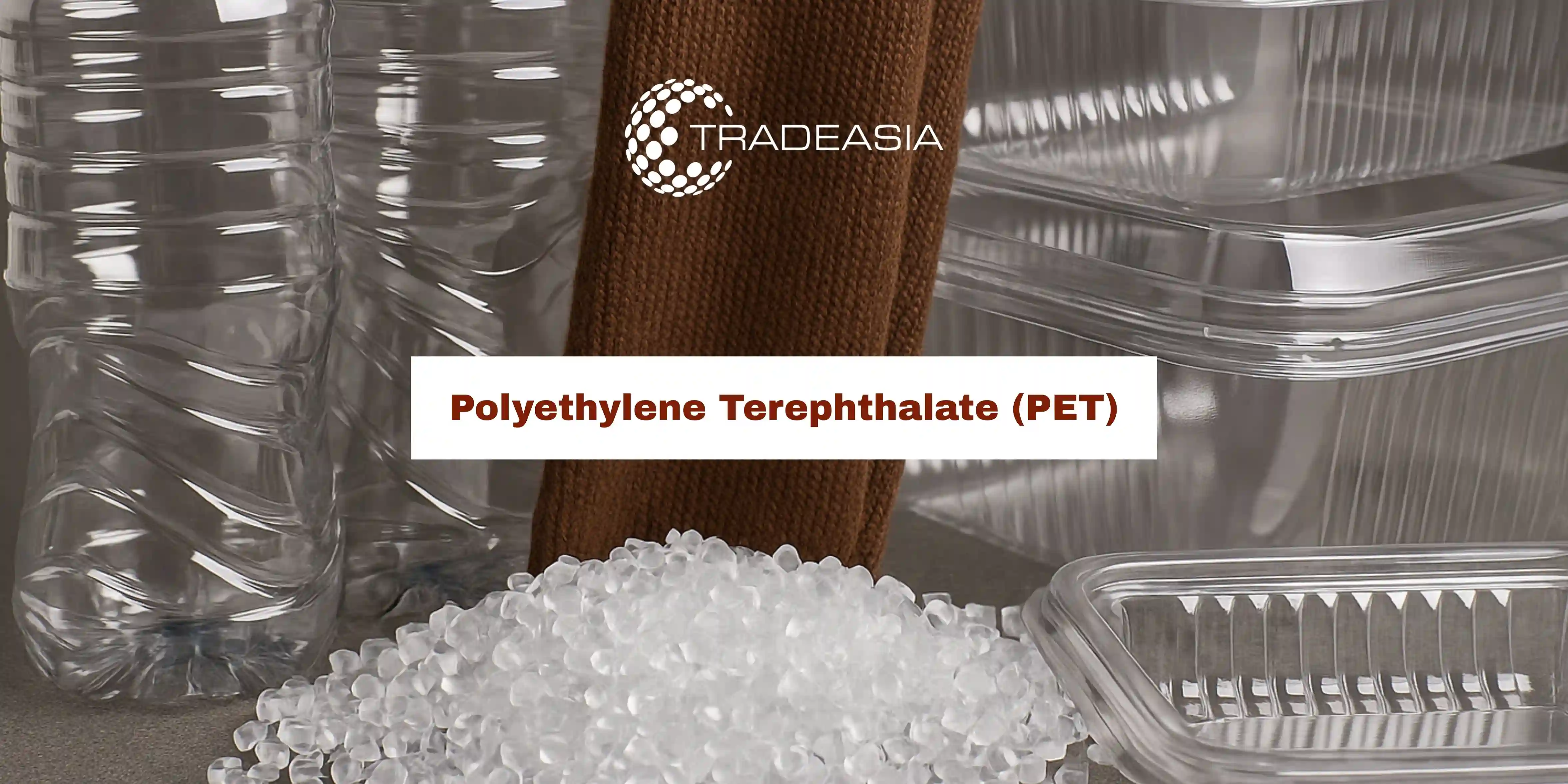
Polyethylene Terephthalate (PET) is a clear, strong, lightweight polyester used across packaging, textiles, and technical films. Its strength-to-weight ratio, optical clarity, and decent gas barrier—combined with high recyclability—make PET a cornerstone for modern circular packaging.
PET dominates beverage bottles via Injection Stretch Blow Molding (ISBM) thanks to clarity, impact strength, and CO₂/O₂ barrier suitable for water, CSD, and juices. Explore bottle-grade options on our PET Resin page.
In thermoforming, A-PET enables transparent trays/clamshells, while C-PET (heat-set, semi-crystalline) supports hot-fill and ovenable trays with better thermal stability—solutions often specified by industry technical guides.
Brand owners increasingly specify 20–50% rPET content; maintaining taste neutrality requires acetaldehyde control and clean feedstock. See food-contact guidance from the US FDA.
Roughly half of global PET becomes polyester fibers. Apparel blends benefit from wrinkle resistance and durability, while industrial yarns provide dimensional stability for belts, geotextiles, and cord. Check segment use on our Textile Industry page.
rPET fiber from bottles can match virgin performance when intrinsic viscosity (IV), contamination, and yellowing are controlled throughout flake → pellet → spin. Value-chain guidance from Petcore Europe outlines best practices for rPET conversion.
Biaxially oriented PET (BOPET) delivers high tensile strength, dimensional stability, and elevated use temperature. It’s a mainstay in flexible packaging laminates, labels, electrical insulation, and release liners.
Coatings (e.g., acrylic, PVdC, AlOx) boost printability and barrier. Versus OPP, BOPET offers higher modulus and heat resistance—valuable in retortable structures when laminated correctly.
Mechanical recycling (collection → sorting → washing → flaking → re-pelletizing) is the workhorse route; “super-clean” decontamination can deliver food-grade rPET when clear bottle feedstock dominates—see policy context at the US EPA.
Chemical recycling (glycolysis, methanolysis, hydrolysis) depolymerizes PET to monomers/oligomers (e.g., BHET/TPA/EG) for repolymerization—useful for colored/contaminated streams, albeit with higher capex/opex. Recovery and recycling principles are summarized in ISO 15270.
For food packaging, monitor acetaldehyde, overall/specific migration, IV, APHA color, moisture, and heavy metals. Maintain DoC, COA, and lot traceability—especially for rPET. Refer to FDA guidance on recycled plastics in food packaging and Download Center for product documentation.
For market/technology context, see PlasticsEurope PET resources.
We're committed to your privacy. Tradeasia uses the information you provide to us to contact you about our relevant content, products, and services. For more information, check out our privacy policy.


 English
 Indonesian
 简体字
简体字
 العربية
 Español
 Français
 Português
 日本語
日本語
 한국어
한국어
 Tiếng Việt