Explore our network of country and industry based websites to access localized information, product offerings, and business services across our group.
Log in to start sending quotation requests for any product.
Don't have an account? Sign Up Here
Home A Compliance-by-Design for Medical & Food-Grade PVC
Trade Insights | Regulatory and Compliance | 13 October 2025
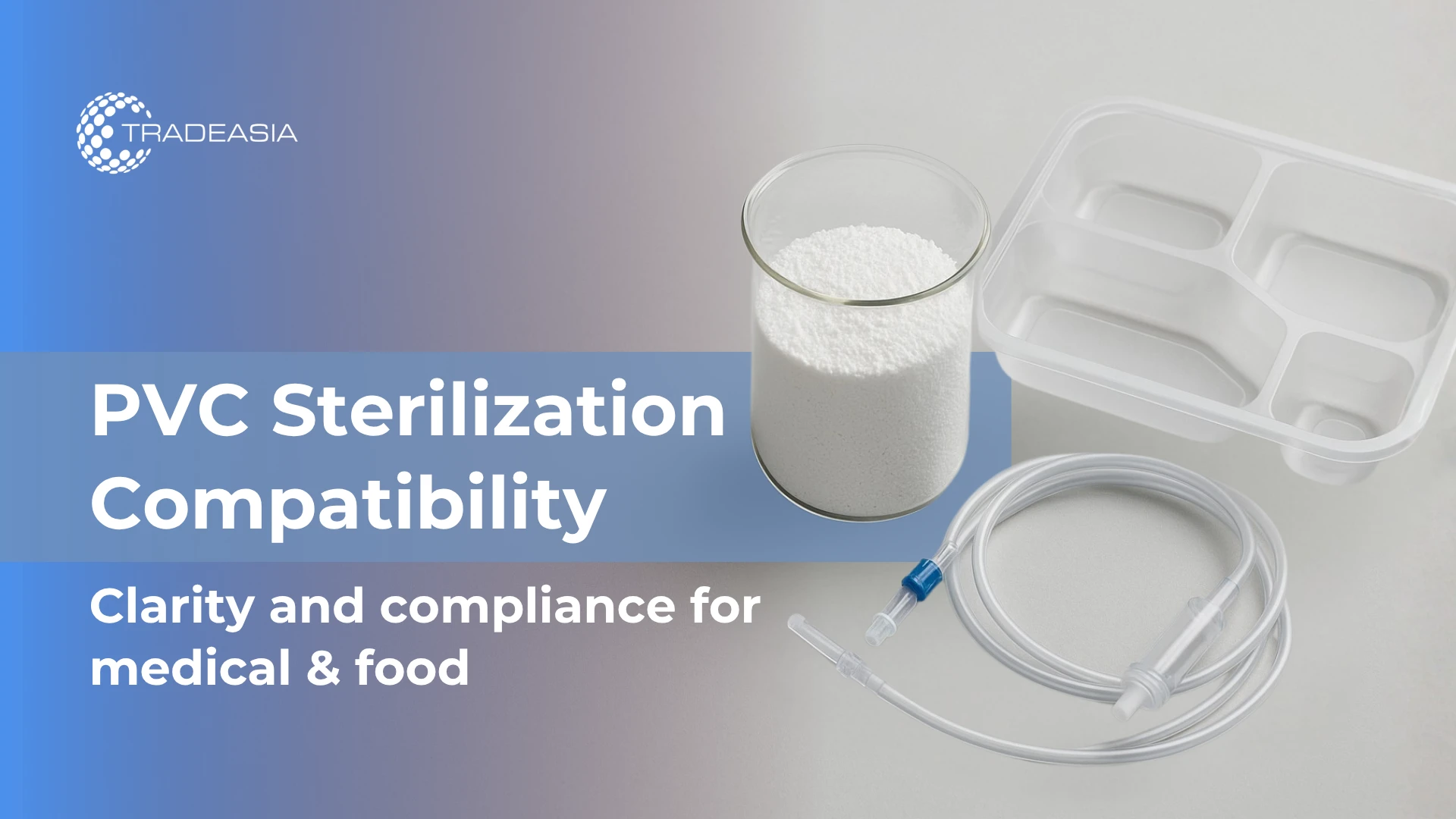
Medical and food-contact PVC compounds must balance performance with stringent regulatory expectations. This guide covers compliant plasticizer choices (DEHP-free), sterilization compatibility, extractables/leachables (E/L), documentation, and supplier audits—so your teams can scale safely from pilot to validated production.
Food-contact PVC must meet migration limits and positive-list requirements defined by authorities (e.g., FDA and EFSA). For recycled content, consult the U.S. FDA guidance on recycled plastics in food packaging (read more). For the EU, see EFSA’s topic hub for food-contact materials. Medical applications are governed by biocompatibility standards; ISO 10993-1 provides the biological evaluation framework for medical devices.
To meet market and hospital policies, many formulations move to DEHP-free systems: DOTP, DINCH, TOTM, or specialty trimellitates.
PVC compounds for medical devices and some food-processing components must tolerate sterilization without losing mechanical integrity or clarity.
When claiming compatibility, back statements with internal validation plus frameworks such as ISO 10993-1.
E/L programs quantify potential migrants under simulated use. For food-contact PVC, run overall and specific migration per your market’s regime and verify organoleptics (taste/odor). The FDA recycled-plastics guidance explains decontamination validation if recycled inputs are considered. Keep sensory testing protocols standardized (triangle tests, trained panels) and link failures to root-cause—plasticizer purity, stabilizer interactions, or residual solvents/EtO.
Set a lot-release regime covering hardness (Shore A), tensile/elongation, volatility, specific migration, and color (APHA/L*a*b*). Publish COA per lot and maintain a Declaration of Compliance (DoC) mapping composition vs allowable use. Establish change control for supplier/stabilizer/sterilization changes—with re-validation rules.
To keep an accessible for recycled inputs in food packaging, access EFSA’s materials hub.
Audits should verify incoming material controls, batch traceability, calibration of test equipment, operator training, and clean-room/controlled-area practices for medical lines. For global claims around recycling and recovery, anchor SOPs and customer specs to ISO 14443.
Designing compliant PVC compounds is faster when you standardize documentation, choose DEHP-free plasticizers fit-for-purpose, validate sterilization, and run disciplined E/L programs. If you need medical- or food-grade PVC Resin with the paperwork ready, you can source it directly from Tradeasia—specifications and requests on our PVC Resin Product Page. Lot-specific COAs are available via the our Download Center to speed up qualification. For more exploration about other PVC Products, access our PVC Product Category.
We're committed to your privacy. Tradeasia uses the information you provide to us to contact you about our relevant content, products, and services. For more information, check out our privacy policy.


 English
 Indonesian
 简体字
简体字
 العربية
 Español
 Français
 Português
 日本語
日本語
 한국어
한국어
 Tiếng Việt