Explore our network of country and industry based websites to access localized information, product offerings, and business services across our group.
Log in to start sending quotation requests for any product.
Don't have an account? Sign Up Here
Home PVC Resin in 2026: Short-Term Price Support, Long-Term Structural Weakness
Trade Insights | Supply Chain | 02 April 2026
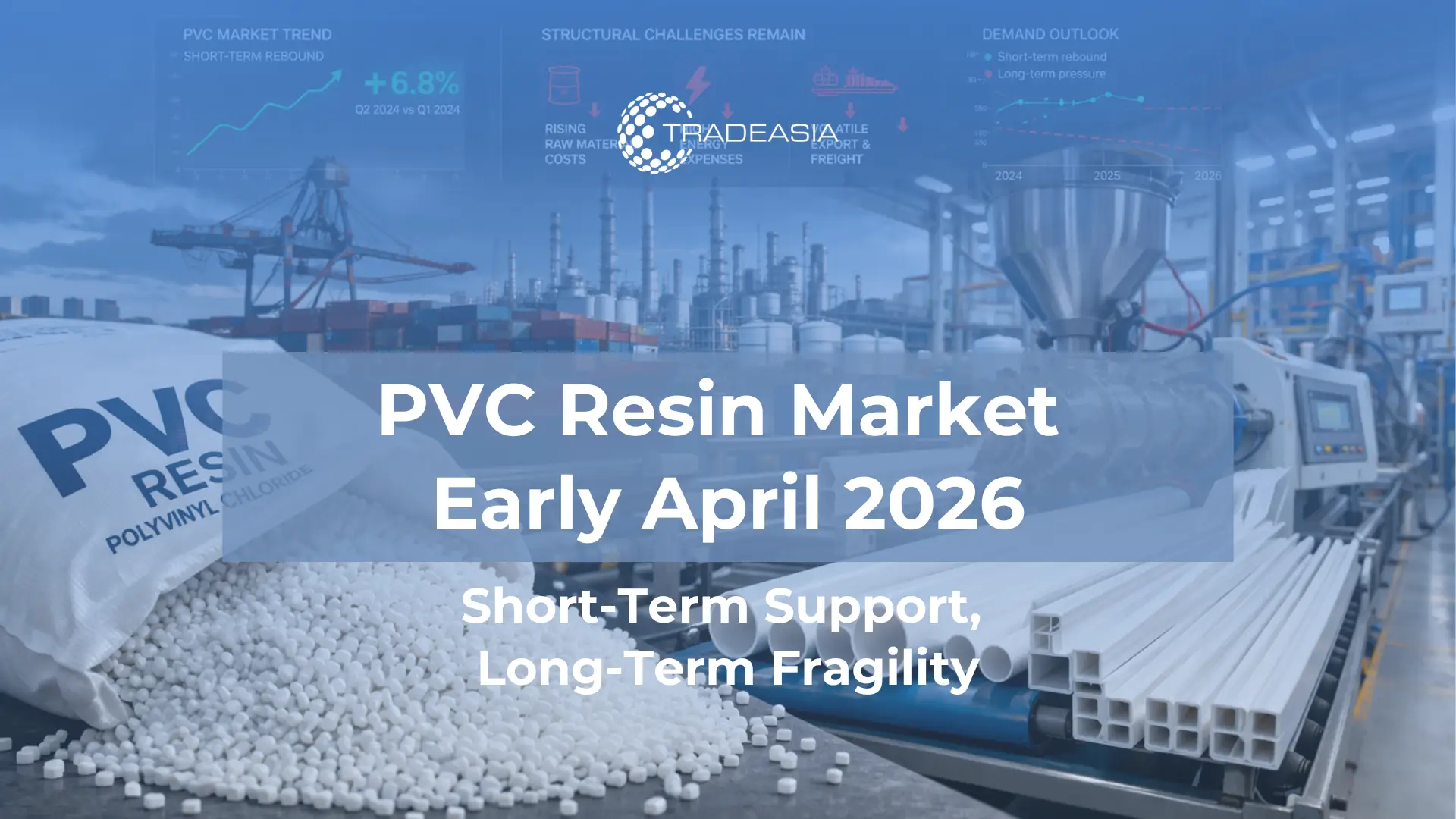
PVC Resin Market 2026: Recovery Signals, Weak Foundations
PVC Resin Oversupply 2026 Still Shapes Global Trade
Weak Construction Demand Limits Downstream Recovery
Feedstock Swings and Policy Risks Distort Pricing
Regional Buying Patterns Are Shifting Across Asia
Conclusion: What Buyers Should Watch in a Fragile Market
The pvc resin market 2026 has shown short-term firmness, but the broader structure remains fragile. A benchmark-tracking polyvinyl market indicator cited by TradingEconomics rose 10.73% over the previous month by April 2, 2026, showing that a pvc resin price rebound has taken hold in the opening weeks of the second quarter. However, current market commentary from S&P Global still describes the sector as one that is searching for durable balance rather than entering a clear new upcycle. (Trading Economics)
According to S&P Global, the market entered 2026 after a year of falling PVC prices and without clear signs of robust recovery in regional construction industries, while expectations for production cuts were gaining strength. That combination explains why the recent pvc resin price trend looks supportive in the short term, but still lacks the demand foundation normally needed for lasting stability. (S&P Global)
Market analysis published by ICIS in June 2025 warned that the global PVC market was heading into a significant supply surplus, largely because of rising Chinese exports and weaker demand conditions. That oversupply did not disappear when 2026 began, so even when prices rise for a few weeks, the market is still carrying the weight of excess material and weak margins. (ICIS Explore)
This is why buyers should separate short-term support from structural improvement. In practical terms, the pvc resin price rebound is real, but the market remains vulnerable because global pvc resin supply is still heavy and the conditions for a sustained rerating have not yet been fully restored. (Trading Economics)
The biggest structural problem remains excess supply. ICIS stated that the global PVC market was poised for a significant surplus because of Chinese export growth and weak demand, and that legacy still informs pricing behavior in 2026. This means pvc resin oversupply 2026 is not a new issue on its own, but the continuation of a surplus pattern that intensified during 2025. (ICIS Explore)
S&P Global also expects export activity to remain elevated in 2026, with a larger annual export PVC volume driven in part by India’s growth and imports from China, Taiwan, Japan, South Korea, and the United States. That reinforces the idea that producers are still relying on external markets to offset soft domestic demand rather than benefiting from a synchronized recovery across regions. (S&P Global)
Trade flow data from S&P Global further shows how export dependence is reshaping regional competition. In Europe, imports from Asia rose sharply after the EU imposed definitive antidumping duties on US- and Egypt-origin PVC, with South Korea, China, and Taiwan all increasing volumes into the bloc. (S&P Global)
That kind of redirection keeps international competition intense and limits how far prices can recover before sellers start defending volume again. As long as producers in China and other Asian markets continue to chase export outlets aggressively, the pvc resin market 2026 will remain supply-heavy and highly sensitive to changes in freight, tariffs, and buyer sentiment. (S&P Global)
Construction remains the single most important downstream sector for PVC. S&P Global says the industry entered 2026 without concrete signs of robust growth in regional construction markets, which is one of the clearest reasons why recovery remains fragile. Without stronger pvc resin construction demand, the market lacks the volume base needed to absorb surplus output consistently. (S&P Global)
At the same time, the broader demand case for PVC is still intact over the longer term. Fortune Business Insights notes that PVC continues to be widely used in construction, transportation, packaging, electrical and electronics, and healthcare, while Future Market Insights identifies construction as the largest end-use segment and also highlights packaging and electrical applications as meaningful demand channels. (Fortune Business Insights)
Those applications matter because pvc resin packaging applications and cable-related demand can provide support when building activity is soft. Even so, they are not yet strong enough to fully counter the weakness in construction-led consumption, especially in a market already carrying too much supply. (Fortune Business Insights)
In other words, pvc resin downstream demand recovery is incomplete. Until growth in construction, packaging, and electrical applications becomes broad enough to absorb surplus export material at healthier margins, the market is likely to remain rangebound and fragile rather than genuinely rebalanced. (S&P Global)
Short-term price support is also being influenced by upstream cost movement. ChemOrbis reported that European PVC sellers were preparing March hike attempts in line with a projected rise in the March ethylene contract, although weak demand and ongoing competition were expected to cap the upside. That is the clearest current example of how the ethylene price impact pvc relationship can temporarily support offers without solving the deeper supply problem. (chemorbis.com)
That feedstock effect helps explain why prices can rebound even inside a structurally soft market. A rising cost base can encourage sellers to test higher numbers, but if demand remains weak and exporters still need to move volume, those increases often become difficult to sustain beyond the immediate feedstock window. (chemorbis.com)
Trade-policy risk is adding another layer of fragility. S&P Global says 2026 export flows will still be shaped by tariffs and trade implications, while the European market has already shown how antidumping measures can change competitive positioning and redirect Asian material toward whichever regions remain open and profitable. (S&P Global)
India’s Directorate General of Trade Remedies also shows that PVC-related trade-defense activity is active in 2026, including an anti-dumping investigation concerning PVC paste resin from the European Union and Japan. Even though that case is not the same as suspension-grade resin, it illustrates that policy risk remains part of the broader commercial environment, which affects how Asian cargoes are evaluated and where they can move most profitably. (dgtr.gov.in)
Asia remains the center of gravity for the market. S&P Global expects India’s import growth to remain an important driver of export flows, and Fortune Business Insights says Asia Pacific held the largest share of the PVC market in 2025, supported by demand from construction, infrastructure, and manufacturing sectors in China, India, and Southeast Asia. That combination is making regional buying patterns more dynamic in 2026. (S&P Global)
For industrial buyers looking to compare current commercial supply options, the PVC resin product portfolio provides a ready-to-use sourcing reference within a market that remains highly competitive and export-driven. In an environment where price support is fragile, buyers increasingly want visibility on both commercial availability and grade suitability before committing cargoes. (plastradeasia.com)
Qualification speed matters more when pricing is unstable and offers can change quickly. The Plastradeasia download center is useful for reviewing technical files and product documents earlier in the sourcing process, which can shorten approval cycles when market windows are narrow. (plastradeasia.com)
This is also where the role of a bulk pvc resin distributor becomes more strategic. Buyers are becoming more selective about partners that can provide fast documentation, clear commercial communication, and realistic shipment expectations, because pvc resin procurement strategy in 2026 depends as much on execution discipline as on headline price. (S&P Global)
The overall picture is clear: the pvc resin market 2026 is showing signs of life, but those signals sit on top of unresolved structural weakness. Current price support has come from feedstock changes and tactical restocking, yet the market still faces excess supply, persistent export dependence, and no decisive recovery in end-use construction demand. (Trading Economics)
That is why buyers should stay disciplined. A sound pvc resin procurement strategy in this market means tracking export pressure from Asia, monitoring feedstock-driven offer changes, and watching whether real pvc resin downstream demand recovery appears in construction, packaging, and electrical applications rather than assuming that a short-term rebound proves the cycle has turned. (chemorbis.com)
For teams that need current sourcing support, it is practical to combine the PVC resin product portfolio with the Plastradeasia download center, then move quickly into direct supply discussions through Plastradeasia contact support. That approach is especially useful in a fragile market where the best decisions depend on both technical readiness and commercial timing. (plastradeasia.com)
Long-term stability will still depend on output discipline and a real rebound in end-use demand, not only on temporary price support. Until those conditions improve, PVC is likely to remain a supply-heavy, export-dependent market where recoveries can happen, but where broader structural weakness still defines the trading environment. (S&P Global)
We're committed to your privacy. Tradeasia uses the information you provide to us to contact you about our relevant content, products, and services. For more information, check out our privacy policy.


 English
 Indonesian
 简体字
简体字
 العربية
 Español
 Français
 Português
 日本語
日本語
 한국어
한국어
 Tiếng Việt




















