Explore our network of country and industry based websites to access localized information, product offerings, and business services across our group.
Log in to start sending quotation requests for any product.
Don't have an account? Sign Up Here
Home Chemical Recycling in 2026: DEG vs EG in PET Glycolysis—What Determines BHET Yield and Quality?
Trade Insights | Applications and Buyers | 06 January 2026
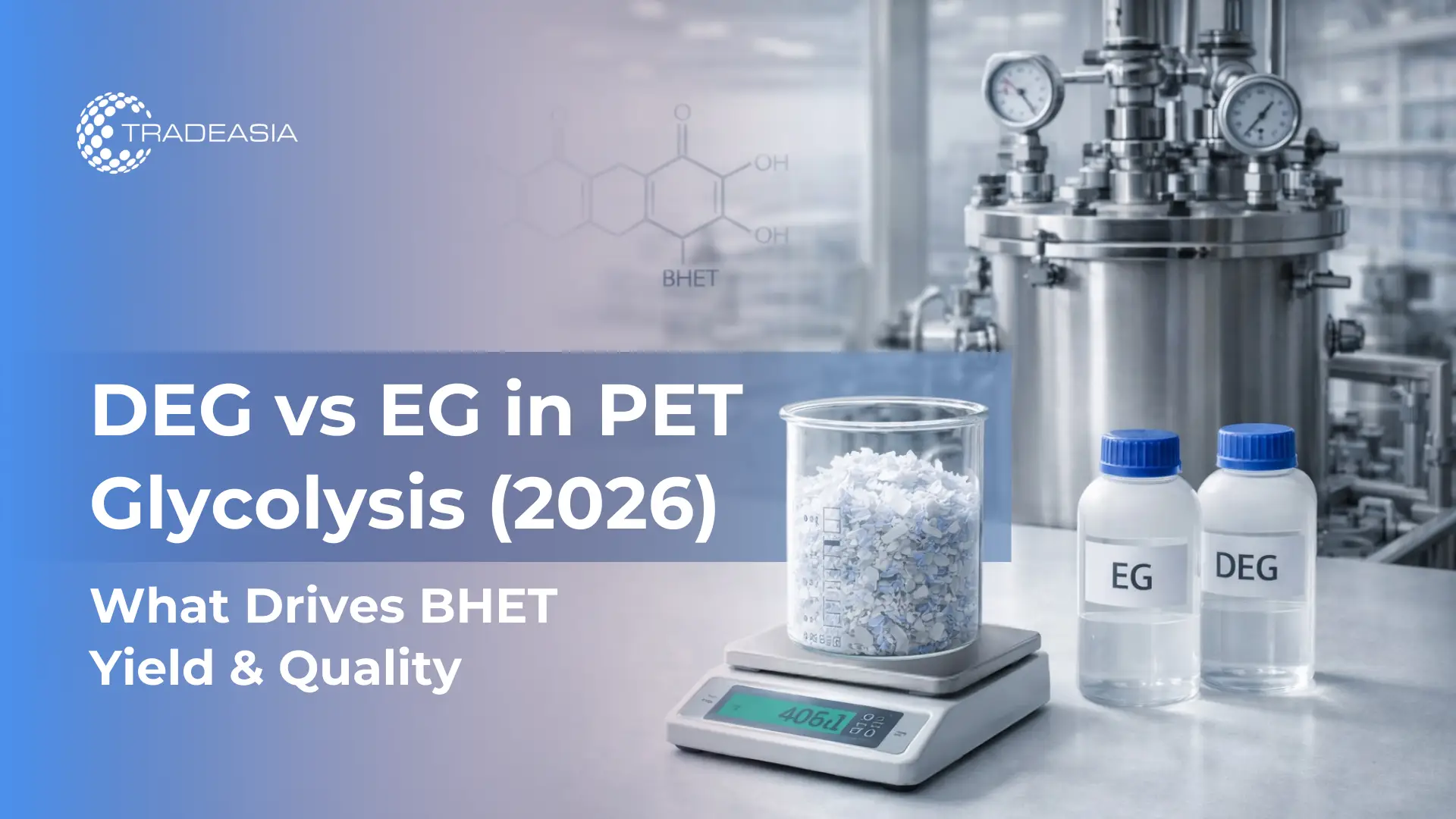
Chemical recycling is moving from “pilot headlines” to procurement reality, especially for polyester streams where glycolysis can recover monomers for repolymerization. In this environment, the question “DEG vs EG?” is not academic—your glycol choice can change conversion speed, product distribution, purification load, and whether your monomer stream is suitable for downstream polymer production.
A second 2026 driver is governance: companies are being asked to back recycled-content or circularity claims with clearer methodologies, traceability, and technical proof. When the feedstock is PET waste, decision-makers increasingly evaluate chemical recycling pathways by what products are made (monomers vs fuel-range streams) and how confidently outputs can be reintroduced into polymer value chains.
Recent working-paper literature continues to emphasize the importance of clearly defined system boundaries, verification and reporting for chemical recycling claims—especially when recycled feedstock allocation or “counting” approaches are debated across markets. SSRN
To keep your PET chemistry baseline aligned before discussing glycolysis inputs and outputs, anchor your internal stakeholders on PET resin fundamentals and sourcing terminology here:
At its core, PET glycolysis is a transesterification reaction: PET chains are broken down in the presence of a glycol to generate monomers/oligomers. With ethylene glycol (EG), the target is commonly BHET, while alternative glycols can shift distribution toward different oligomers and end products—meaning “yield” must be defined carefully (isolated BHET vs total depolymerization vs monomer selectivity).
For commercial decision-making, BHET yield alone is not enough. Buyers should also ask about BHET purity, catalyst residue risk, color/impurity profile, and whether the recovered monomer is designed for repolymerization or for “downstream polyester” markets such as unsaturated polyester resins (UPR). In 2026, that distinction matters because quality determines market acceptance.
A widely cited ACS Engineering Au study on PET glycolysis using niobia-based catalysts demonstrates how catalyst selection and operating conditions materially affect PET conversion and BHET yield—reinforcing why “same PET, different process” can deliver very different monomer quality outcomes. ACS Publications+1
If your glycolysis route is EG-led, your solvent/reactant supply chain should be treated like a strategic raw material program—start by mapping qualified monoethylene glycol suppliers and typical industrial specifications here:
In operational terms, EG glycolysis performance usually pivots around a familiar set of levers: temperature window, reaction time, glycol-to-PET ratio, catalyst type/loading, mixing/particle size, and the degree of contamination in PET input. Because recycled PET streams vary widely, the “best” recipe is often the one that remains stable under realistic feedstock noise.
While your chosen glycol might be EG or DEG, optimization methodologies matter—especially for comparing routes. A University Malaysia Pahang thesis on glycolysis optimization (using PEG as the depolymerization agent) highlights a structured approach: systematically testing time/temperature/catalyst/loading effects and using analytical characterization (DSC/TGA/FTIR) to confirm product properties and yield outcomes. umpir.ump.edu.my
For 2026 programs, the key buyer takeaway is this: you should require suppliers to define yield in the same way you will verify it (e.g., isolated crystalline monomer yield vs conversion), and to specify analytical methods used for characterization. This is how you avoid “paper yield” that collapses during scale-up or when feedstock changes.
And because glycol choice often expands beyond EG/DEG in real factories (especially when tailoring oligomer distributions), buyers comparing mono propylene glycol suppliers should treat MPG as a relevant benchmarking glycol in broader polyester chemistry discussions—even if your main PET glycolysis path remains EG-led:
Diethylene glycol (DEG) is not just a substitute solvent—it can reshape glycolysis outputs. Depending on process design, DEG can promote formation of DEG-based monomer species (often described as BHDET-type products) and shift oligomer profiles, which changes purification steps and end-use suitability. For some value chains, this is beneficial; for others, it introduces complexity.
A recent Springer study explicitly compares glycolysis using EG versus DEG, reporting BHET as the EG-based product and BHDET as the DEG-based product, and investigates how temperature, time, and ratios influence conversion and isolated yield outcomes. This is exactly the kind of comparative evidence procurement teams should demand when choosing DEG vs EG pathways for 2026 chemical recycling projects. Springer
Commercially, the route decision should be tied to your downstream target: do you want BHET for PET repolymerization compatibility, or are you aiming for broader polyester intermediates where DEG-containing products fit? The “right” glycol is the one that yields the product slate your market can absorb—at the purity you can guarantee.
When your strategy requires DEG (either as a primary glycolysis reactant or as part of a broader polyester intermediate supply chain), keep your sourcing reference clear and procurement-ready with verified Diethylene Glycol suppliers here:
In 2026, “good BHET” increasingly means repolymerization-ready: stable melting behavior, low catalyst residue, controlled color, and a purity profile that does not introduce defects into new polymer chains. In other words, quality is defined by downstream performance, not only by lab yield.
A 2024 mini-review in the Journal of Environmental Chemical Engineering frames glycolysis as a promising pathway but stresses recurring challenges: contaminant removal, scale-up, economic viability, and the importance of catalyst optimization and end-product quality for market acceptance. JCU ResearchOnline These points translate directly into buyer due diligence: if quality and purification are not engineered into the process, “high yield” may still produce low-acceptance output.
This is why the best chemical recycling supply programs pair process claims with hard documentation—COAs, method references (HPLC/GC/FTIR/DSC), and impurity thresholds aligned to the intended reuse route. Done well, this reduces dispute risk and accelerates qualification across pet Polyethylene Terephthalate suppliers and glycol vendors.
To operationalize this in procurement, standardize how your teams access specs, SDS/TDS, and supporting files for PET and glycols via a single documentation workflow:
Your 2026 buyer checklist should start with one principle: chemical recycling credibility is built on traceable inputs + transparent allocation/explanation + auditable documentation. Even before you evaluate DEG vs EG, validate feedstock controls (PET bale specs/contamination), and require the supplier to define what outputs are produced and which ones are intended to return to polymer production.
Industry guidance documents on chemical recycling and mass-balance accounting emphasize why traceability and consistent accounting approaches matter when chemically recycled outputs are mixed with conventional feedstocks. This is critical for buyers because “counting” and “claiming” often depend on the evidence trail, not only the chemistry. Plastics Europe
From a practical procurement angle, write your RFQs to force clarity: (1) define output slate (BHET vs oligomers vs other), (2) specify verification methods and acceptance criteria, (3) demand documentation packs before trial approval, and (4) align contract language to how you will audit claims. This is how you protect your recycled-content strategy while keeping production stability.
When you’re ready to secure supply, validate technical requirements, or coordinate PET and glycol sourcing at scale (including polyethylene terephthalate suppliers and monoethylene glycol suppliers), engage the Plastradeasia team for bulk orders and technical alignment:
In 2026, DEG vs EG is best treated as a decision framework: EG routes often target BHET directly, while DEG routes can shift product distribution and purification needs. What determines success is not only yield—it’s repeatable quality, verification readiness, and a procurement model that aligns output claims with downstream reuse requirements.
If your starting point is PET sourcing and internal specification alignment, use PET resin fundamentals as your baseline reference before comparing chemical recycling routes and vendor claims:
If your route requires glycols, map qualified suppliers by intended chemistry: secure DEG supply for DEG-led product slates (and DEG-containing intermediates) here DEG Diethylene Glycol Product Page by Plastradeasia and secure EG supply for BHET-focused pathways here Monoethylene Glycol Product Page by Plastradeasia; if you benchmark alternative glycols for polyester chemistry decisions, keep MPG sourcing visibility here Mono Propylene Glycol Product Page by Plastradeasia.
Finally, make your program audit-proof and execution-ready: centralize documentation (SDS/TDS/specs/COA) via Technical Library List by Plastradeasia, then move quickly from qualification to contracting by engaging the team for bulk orders, technical support, and supplier coordination at Contact our team Now!
We're committed to your privacy. Tradeasia uses the information you provide to us to contact you about our relevant content, products, and services. For more information, check out our privacy policy.


 English
 Indonesian
 简体字
简体字
 العربية
 Español
 Français
 Português
 日本語
日本語
 한국어
한국어
 Tiếng Việt