Explore our network of country and industry based websites to access localized information, product offerings, and business services across our group.
Log in to start sending quotation requests for any product.
Don't have an account? Sign Up Here
Home Chemical Recycling vs Mechanical Recycling in 2026: What Counts Toward Recycled-Content Targets
Trade Insights | Applications and Buyers | 31 December 2025
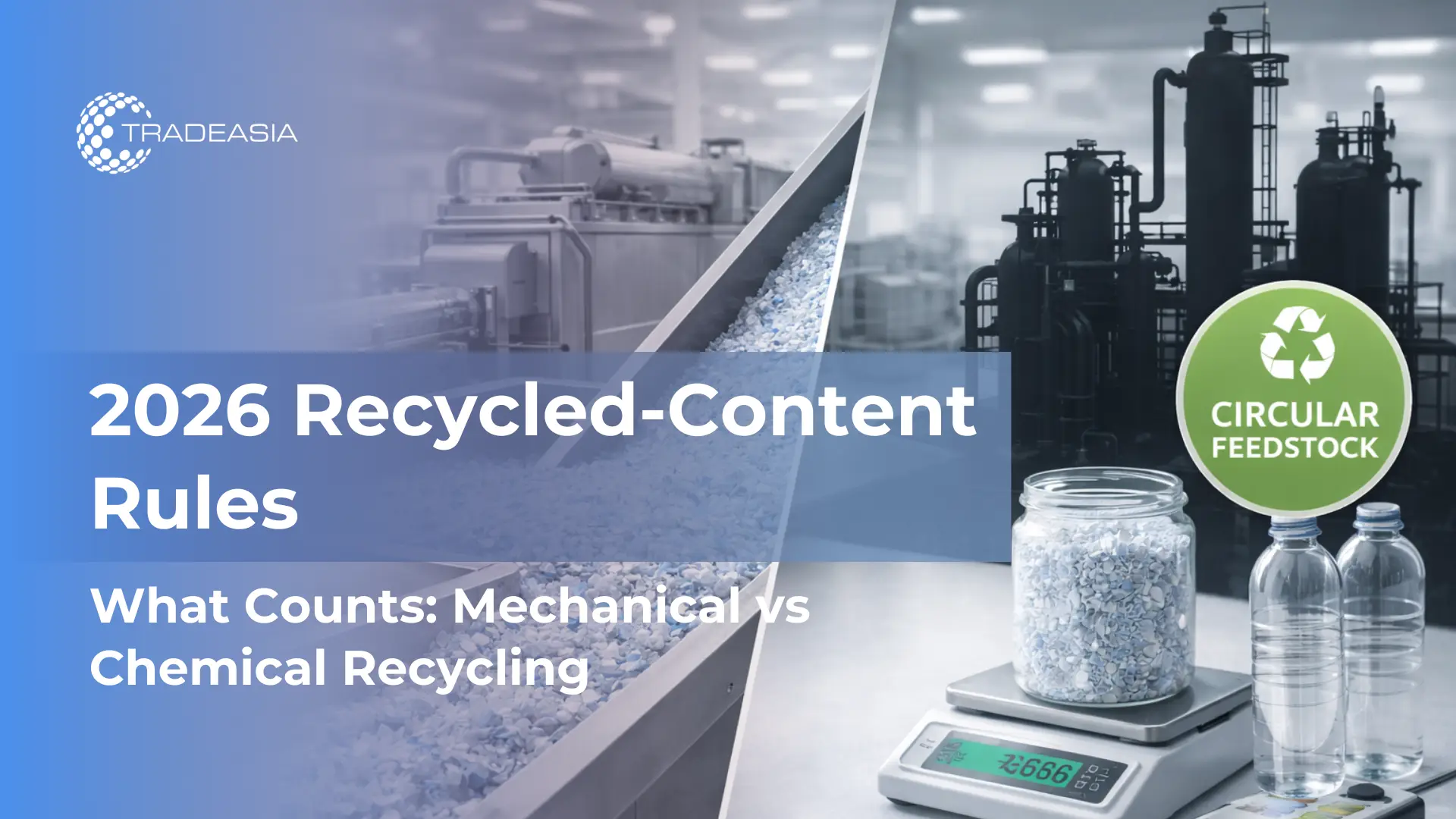
Recycled-content targets in 2026 won’t be decided by marketing language—they’ll be decided by accounting rules, verification, and audit-proof documentation. For procurement teams buying pet, high density polyethylene, and pp homopolymer grades, the key question is no longer “Do you offer recycled content?” but “Does your recycled content count under the rules my customers and regulators follow?” ScienceDirect
That question is getting sharper because “recycled content” can originate from two very different pathways: mechanical recycling (sorting, washing, remelting) and chemical recycling (depolymerization/pyrolysis/gasification routes that convert polymers into feedstocks). Many supply chains rely on mass balance for chemical routes, which creates compliance complexity and demands clear, standardized allocation.
This matters most for packaging: polyethylene terephthalate pet market requirements, bottle-to-bottle targets, and brand mandates are pushing buyers to lock in supply early—especially when you’re qualifying pet polyethylene terephthalate supplier options with strict specs and traceability expectations. Environment
If your sourcing program still uses generic “recycled” descriptions, start by aligning resin language and specifications internally (procurement + QA + R&D) using a shared PET resin reference point:
In most regulatory and customer-audit contexts, mechanical recycling remains the clearest and easiest-to-verify pathway: post-consumer plastic is collected, sorted, washed, and reprocessed into flakes/pellets that can be incorporated into new products. Because the physical material is directly recovered and reprocessed, “counting” the recycled content is usually more straightforward—provided chain-of-custody and test methods are in place. MDPI
However, mechanical recycling is not frictionless. Contamination (labels, incompatible polymers), degradation, and inconsistent feedstock quality can reduce yield and limit which applications can accept recycled material—especially in demanding packaging and high-performance markets. Peer-reviewed reviews consistently highlight sorting/cleaning constraints as major mechanical recycling bottlenecks. ScienceDirect
For buyers, the operational implication is that mechanical recycled content “counts” most reliably when the incoming stream is controlled (deposit systems, strong bale specs) and when the recycler provides stable specifications (MFI/IV, color, contaminants) across lots. This is why high density polyethylene supplier decisions for packaging and consumer goods often include strict incoming QC and multi-supplier qualification.
If you’re linking recycled-content planning to a core virgin resin baseline—especially for blow molding and rigid packaging—use an HDPE product reference as a specification anchor for procurement and QA alignment:
Chemical recycling is often used as an umbrella term, but in compliance discussions it must be defined precisely: depolymerization routes (e.g., PET back to monomers) differ from pyrolysis routes (often used for polyolefin waste to produce oils that can be cracked into new polymers). Because chemical outputs can be mixed with fossil feedstocks at scale, mass balance allocation becomes central to “what counts.”
In the EU, the direction of travel is toward clearer methodologies for calculating chemically recycled content—especially for beverage bottles—so that claims are transparent and comparable across suppliers. The European Commission has explicitly framed new rules as a way to ensure transparency in how chemically recycled content is calculated. Environment
Industry coverage of the EU approach highlights a key phrase buyers should understand: “fuel-use excluded” mass-balance accounting—meaning plastics routed to fuels do not qualify toward certain recycled-content targets, while circular feedstock routes intended to make new plastics can qualify under defined allocation rules.
Because chemical recycling is often discussed in the context of mixed polyolefin streams (including films), a practical internal reference for buyer discussions on linear low-density polyethylene and flexible packaging sourcing is:
For polyethylene terephthalate pet, mechanical recycling remains the backbone of bottle-to-bottle supply because it is a mature route with established sorting and decontamination practices—yet it still faces constraints (contamination thresholds, color control, IV stability) that determine how much material can realistically qualify for high-value packaging. ScienceDirect
For polyolefins (LDPE/LLDPE/PP), chemical recycling is often positioned as a route for mixed or contaminated streams where mechanical recycling struggles—especially films. But what “counts” depends on whether the chemical output becomes circular feedstock (back into plastics) and whether allocation is accepted under target frameworks. ScienceDirect
This is where procurement language must be exact: “recycled” can mean mechanically recycled resin, chemically recycled feedstock allocated via mass balance, or—critically—plastic converted to fuel (which may not count toward recycled-content obligations depending on the scheme). Buyers should require suppliers to specify which pathway applies and provide evidence suitable for audits. ScienceDirect
If your packaging portfolio includes BOPP films and you want a clean internal anchor for pp homopolymer supplier conversations (including circular claims and documentation expectations), use:
One of the biggest “counting” pitfalls in 2026 is confusing chemical recycling to circular plastics with chemical conversion to fuels. Some advanced pyrolysis routes can produce fuel-range hydrocarbons efficiently, but fuel outputs are typically treated differently (and often excluded) when the target is recycled content in new plastic products. Plastics Today
Recent reporting on Yale’s “electrified pyrolysis” highlights this tension clearly: it emphasizes strong conversion to fuel-range molecules (jet/diesel range), which is promising for waste reduction but not automatically a pathway that qualifies as recycled content in plastic packaging targets. New Haven Register
Peer-reviewed reviews of pyrolysis and chemical recycling also emphasize that the end-use route matters: producing fuels, chemicals, or circular polymer feedstocks are not equivalent outcomes when compliance is measured by recycled content in plastics. ScienceDirect
For flexible packaging buyers managing linear low density polyethylene and film waste realities, a pragmatic internal reference point (especially when you’re mapping which packaging structures you can redesign for higher mechanical recyclability) is:
In 2026, recycled-content procurement becomes documentation-driven: buyers must validate chain-of-custody, allocation method (if mass balance), test results, and whether the claim aligns with the target framework in the destination market. This is increasingly true as regulators and policymakers tighten scrutiny on recycled-content claims and imported material declarations. Financial Times
Financial and industry reporting has pointed to EU moves aimed at protecting recyclers and improving verification—such as stricter checks on whether imports are genuinely recycled and efforts to differentiate recycled vs virgin via customs coding and documentation.
A practical buyer standard in 2026 is to request a “compliance pack” upfront: spec sheet, SDS/TDS, recycled-content verification methodology, audit pathway, and clarity on whether any output is routed to fuels. Without this, even “cheap recycled supply” becomes a liability when customers challenge claims or when import checks tighten. ICIS Explore
To speed up qualification workflows and ensure your internal teams (QA/procurement) have consistent supplier documentation access, use:
In 2026, what “counts” toward recycled-content targets is less about technology labels and more about accepted accounting rules, the fate of outputs (plastic vs fuel), and audit-ready evidence. Mechanical recycling often counts more directly; chemical recycling can count when allocated transparently and when outputs return to plastics—especially as EU frameworks formalize methodologies.
If you’re setting a compliance baseline for pet polyethylene terephthalate, start with clear resin specification alignment so procurement and QA speak the same language across virgin, mechanically recycled, and chemically allocated supply:
If your portfolio includes rigid packaging and closures, align recycled-content planning with the realities of mechanical recycling constraints and contamination impacts in high density polyethylene streams before contracting a high density polyethylene supplier:
If you buy films (LDPE/LLDPE) and evaluate chemical recycling claims, validate whether the output route returns to plastics (counts) or becomes fuels (often excluded), and use film-grade resin references to keep internal specs consistent:
If your packaging strategy includes BOPP structures, keep pp homopolymer sourcing tied to documentation quality so “circular” claims hold up under customer audits and regulatory scrutiny:
If you need fast access to supplier documentation packs (SDS/TDS/specs) to accelerate qualification and reduce compliance risk, centralize your checks and downloads here:
And if you want to lock supply, align documentation requirements, or build a multi-supplier strategy for 2026 targets with clear commercial terms, contact the Plastradeasia team for bulk procurement and technical support:
We're committed to your privacy. Tradeasia uses the information you provide to us to contact you about our relevant content, products, and services. For more information, check out our privacy policy.


 English
 Indonesian
 简体字
简体字
 العربية
 Español
 Français
 Português
 日本語
日本語
 한국어
한국어
 Tiếng Việt