Explore our network of country and industry based websites to access localized information, product offerings, and business services across our group.
Log in to start sending quotation requests for any product.
Don't have an account? Sign Up Here
Home Polycarbonate with PET Market Outlook 2026: Demand, Supply & Asia Pacific Trends
Trade Insights | Supply Chain | 13 January 2026
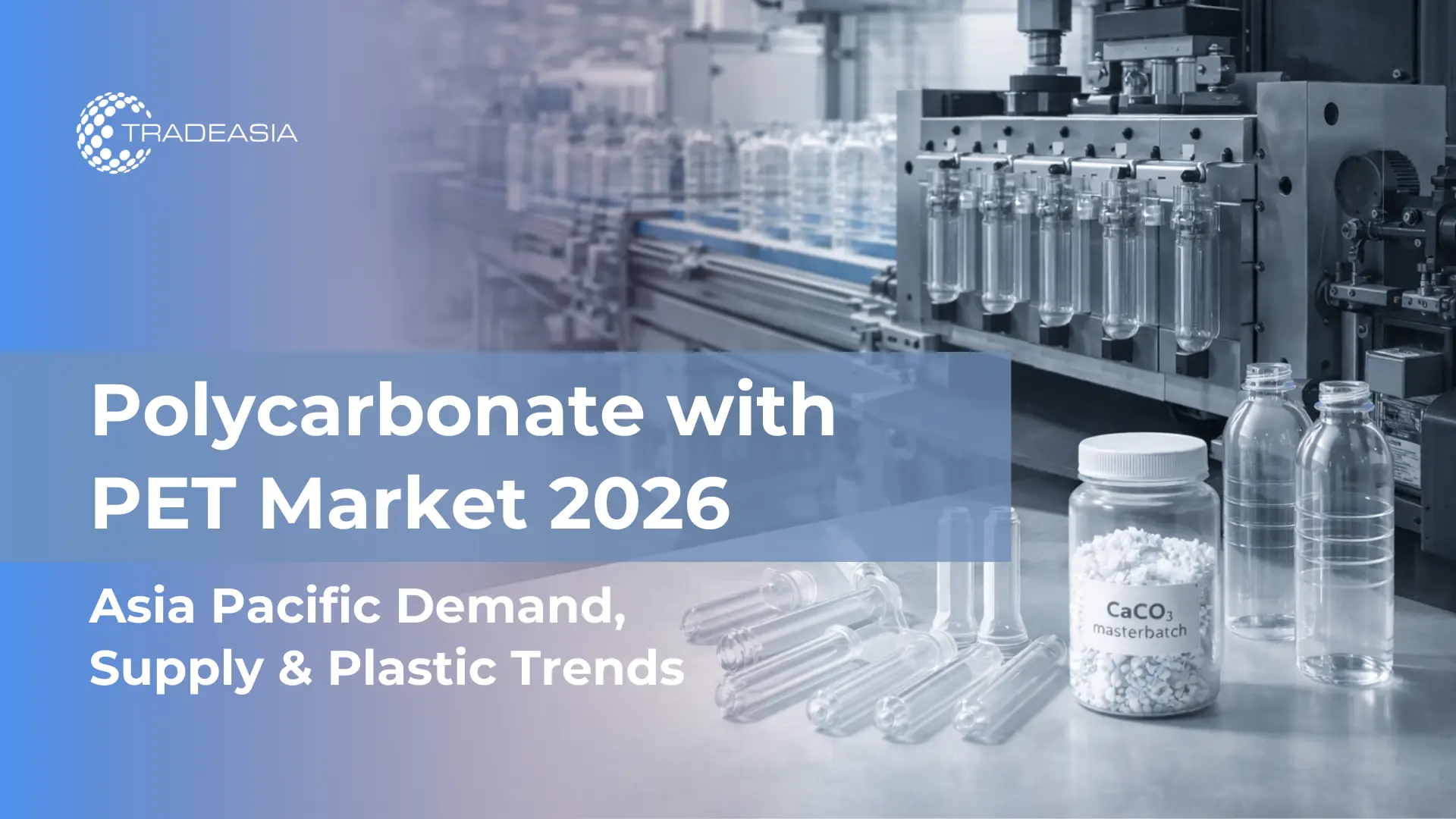
Polycarbonate blended with PET has emerged as a critical engineering plastic solution as manufacturers pursue materials that balance impact resistance, clarity, and processability. In 2026, this blend sits at the intersection of performance plastics and high-volume packaging polymers, making it strategically relevant across Asia Pacific. The material’s ability to bridge cost efficiency and technical performance differentiates it from standalone polycarbonate.
From an application perspective, polycarbonate with PET is increasingly evaluated alongside traditional polymers such as Polyethylene Terephthalate used in rigid packaging and consumer goods. This growing overlap has encouraged converters and OEMs to assess hybrid resin strategies that optimize both performance and price stability. A broader overview of PET market fundamentals can be referenced via Polyethylene Terephthalate.
Industry data published by ScienceDirect highlights that polymer blending has become a preferred pathway to enhance thermal stability and mechanical performance without significantly increasing resin cost. This trend supports the rising interest in polycarbonate–PET systems within electronics housings and transparent components.
As plastic trends in 2026 continue to prioritize lightweighting and durability, polycarbonate with PET positions itself as a commercially viable alternative for manufacturers seeking performance-driven differentiation without overexposure to high-cost resins.
Demand growth for polycarbonate with PET in Asia Pacific is closely tied to expansion in electronics, automotive interiors, and premium packaging segments. These industries require materials that offer clarity, dimensional stability, and resistance to heat and impact. As production volumes increase, buyers increasingly benchmark this blend against conventional low-cost polymers.
In packaging and industrial films, demand comparisons are frequently made with low density polyethylene due to LDPE’s flexibility and price accessibility. However, polycarbonate with PET offers superior rigidity and temperature resistance, allowing brand owners to upgrade packaging performance. A material comparison reference is available through Low Density Polyethylene.
According to Elsevier-published polymer engineering research, Asia Pacific demand for high-performance polymer blends is expected to outpace global averages due to rapid industrialization and technology adoption. This demand trajectory favors PC–PET blends where functional requirements exceed the capabilities of commodity plastics.
Consequently, polycarbonate polyethylene 2026 demand projections suggest sustained growth, especially in markets such as China, South Korea, and Southeast Asia, where advanced manufacturing ecosystems are expanding.
The supply landscape for polycarbonate with PET in Asia Pacific is influenced by resin integration strategies and feedstock availability. Major producers are increasingly optimizing polymerization and compounding facilities closer to end-use markets to reduce logistics risk and cost volatility. This regionalization trend supports stable supply in 2026.
Supply-side comparisons often include linear low density polyethylene, particularly for flexible applications where LLDPE dominates. However, PC–PET blends occupy a higher-value segment with more specialized suppliers. An overview of LLDPE characteristics can be reviewed at Linear Low Density Polyethylene.
According to Mordor Intelligence, Asia Pacific remains the fastest-growing production hub for polycarbonate materials due to strong downstream demand and favorable manufacturing economics. This reinforces supply reliability for polycarbonate blends across the region.
Overall, supply chain resilience in 2026 will favor buyers who engage suppliers with diversified feedstock sourcing and regional warehousing capabilities.
When evaluated against High Density Polyethylene, polycarbonate with PET offers superior heat resistance and transparency, though at a higher material cost. HDPE remains dominant in containers and industrial packaging, but PC–PET blends are increasingly selected for premium and technical applications. Reference material on HDPE properties is available via High Density Polyethylene.
From a performance standpoint, PC–PET blends outperform LDPE and LLDPE in structural rigidity and optical clarity. This allows manufacturers to reduce wall thickness while maintaining product integrity, a key factor in cost optimization strategies for high-value goods.
SpringerLink studies indicate that polymer blends with aromatic polyesters demonstrate improved creep resistance compared to polyolefins, supporting long-term durability claims. This scientific validation strengthens the commercial positioning of polycarbonate with PET.
As plastic trends in 2026 evolve, the competitive landscape will increasingly segment between commodity volume plastics and engineered blends designed for specialized performance outcomes.
Sustainability considerations are reshaping how polycarbonate with PET is specified and sourced. Regulatory pressure across Asia Pacific continues to emphasize recyclability, carbon footprint reduction, and material traceability. Blended polymers must now demonstrate compliance with evolving environmental standards.
Industry stakeholders increasingly analyze polycarbonate–PET recyclability in comparison with mono-material PET systems. Market insights related to PET sustainability trends in Asia can be reviewed via Asia Polyethylene Terephthalate Market Forecast 2026.
MDPI-published research highlights that compatibility agents and improved sorting technologies can significantly enhance the recyclability of polymer blends. These developments are expected to improve acceptance of PC–PET materials under circular economy frameworks.
In 2026, suppliers that align sustainability messaging with technical documentation will gain stronger credibility among multinational buyers and regulators.
Pricing for polycarbonate with PET in 2026 will be influenced by feedstock volatility, energy costs, and regional capacity expansions. Compared to standalone polycarbonate, blended systems offer moderated pricing while retaining functional advantages, making them attractive for cost-sensitive applications.
Buyers often compare PC–PET pricing trends against established commodity polymers such as HDPE and LDPE when negotiating supply contracts. Access to technical documentation and product specifications plays a critical role in procurement decision-making, which can be supported through platforms like the Download Center.
According to TechSci Research, global demand for polycarbonate–polyester blends is projected to grow steadily due to their balanced cost-performance profile. This reinforces the importance of long-term sourcing strategies for industrial buyers.
Effective procurement in 2026 will prioritize supplier transparency, volume flexibility, and technical support rather than price alone.
For buyers, polycarbonate with PET represents an opportunity to differentiate products through performance enhancement while managing cost exposure. Selecting the right supplier becomes critical as quality consistency and technical support directly affect downstream manufacturing efficiency.
Suppliers positioning themselves as hdpe supplier, ldpe supplier, or pet supplier increasingly expand portfolios to include engineered blends. Strategic engagement and customized solutions can be initiated through Contact Us.
Wiley-published market strategy analyses emphasize that supplier diversification and application-driven selling models outperform generic commodity trading approaches. This insight is particularly relevant for polycarbonate–PET blends.
As polycarbonate polyethylene 2026 adoption increases, strategic partnerships between compounders, converters, and OEMs will define market leadership.
The polycarbonate with PET market outlook for 2026 confirms strong demand momentum across Asia Pacific driven by performance requirements, sustainability pressures, and evolving plastic trends in 2026. The blend’s ability to bridge engineering performance and commercial feasibility positions it favorably against traditional polymers.
Compared with materials such as High Density Polyethylene, low density polyethylene, and linear low density polyethylene, PC–PET blends serve a distinct segment focused on durability, clarity, and thermal stability. Buyers referencing Polyethylene Terephthalate, Low Density Polyethylene, Linear Low Density Polyethylene, and High Density Polyethylene can better contextualize material selection strategies.
Market intelligence from Mordor Intelligence and blend-specific insights from TechSci Research further validate the long-term viability of this segment.
Looking beyond 2026, stakeholders that combine technical expertise, transparent documentation via the Download Center, and proactive engagement through Contact Us will be best positioned to capture value in the evolving Asia Pacific plastics market.
We're committed to your privacy. Tradeasia uses the information you provide to us to contact you about our relevant content, products, and services. For more information, check out our privacy policy.


 English
 Indonesian
 简体字
简体字
 العربية
 Español
 Français
 Português
 日本語
日本語
 한국어
한국어
 Tiếng Việt