Explore our network of country and industry based websites to access localized information, product offerings, and business services across our group.
Log in to start sending quotation requests for any product.
Don't have an account? Sign Up Here
Home PVC Resin Market Trends, Applications, and Industry Outlook 2026
Trade Insights | Applications and Buyers | 15 June 2026
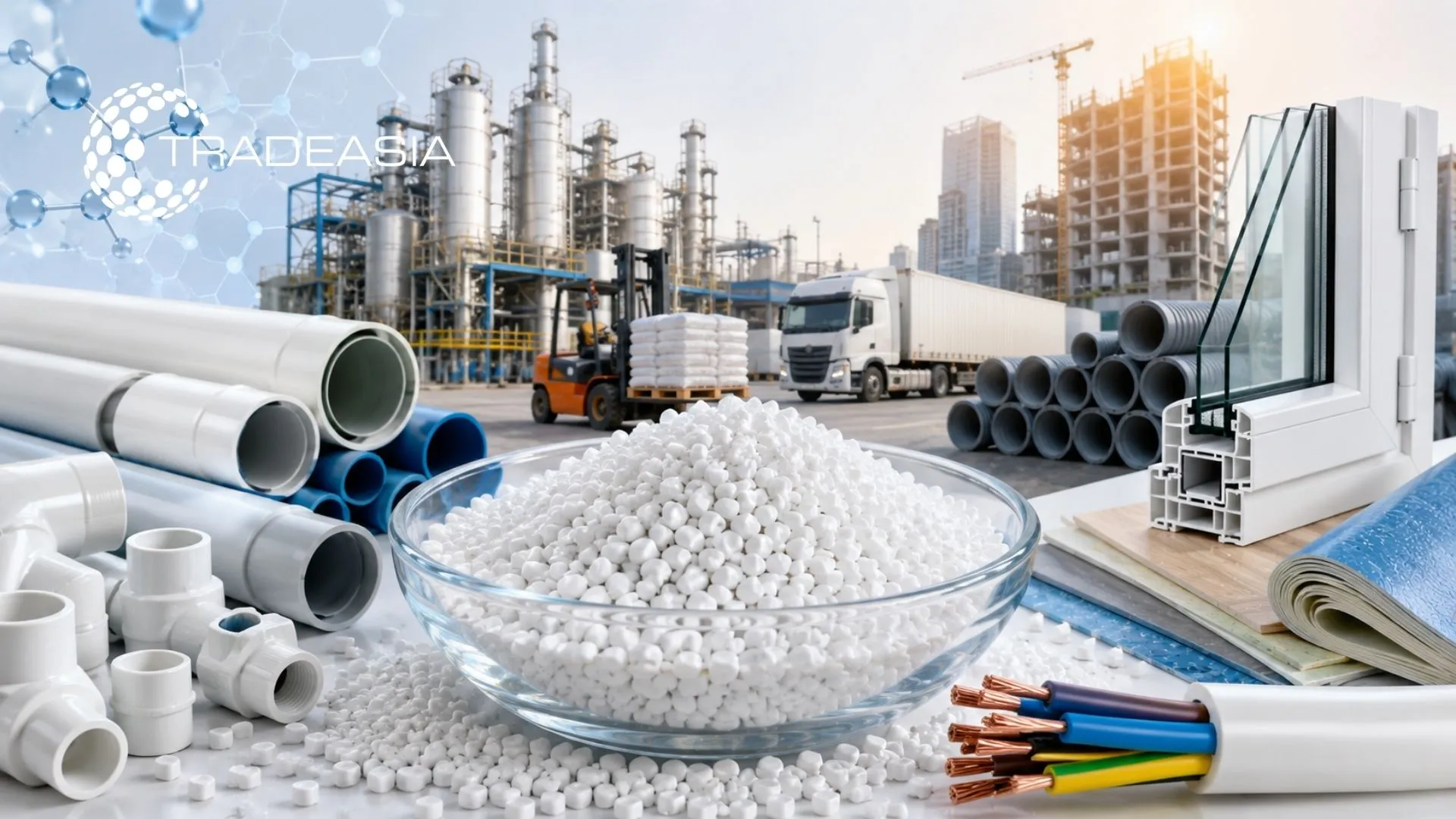
Introduction PVC Resin
Global PVC Resin Market Landscape in 2026
Key Applications of PVC Resin in Plastics and Polymers
Specifications and Grades of PVC Resin for Industrial Buyers
Sourcing, Pricing, and Risk Management for PVC Resin Buyers
Conclusion
The year 2026 is a pivotal point for the global plastics and polymers industry, with PVC resin remaining one of the most widely used and strategically important materials. From construction and infrastructure to healthcare, automotive, and consumer products, PVC resin underpins critical value chains. For application buyers, procurement managers, and technical decision-makers, understanding how PVC resin markets, applications, and specifications are evolving is essential for resilient and cost-effective sourcing.
Globally, PVC (polyvinyl chloride) has consistently ranked among the top three thermoplastics by volume, alongside polyethylene and polypropylene. According to industry analyses, global PVC demand has been growing in the low to mid-single digits annually, driven by urbanization, infrastructure investment, and substitution of traditional materials like metal, glass, and rubber. By 2026, total PVC resin demand is expected to exceed 50 million metric tons per year, with Asia-Pacific remaining the dominant consumption hub.
This article provides a structured, in-depth overview tailored to PVC resin buyers and application developers. It examines market trends, key applications, technical specifications, and sourcing considerations, with a particular focus on how partners such as chemtradeasia can support global procurement strategies. While the emphasis is on market and application insight, readers are encouraged to cross-check any technical or safety-related details with authoritative sources.
By 2026, the global PVC resin market is characterized by regional imbalances in capacity, evolving trade flows, and increasing scrutiny on environmental performance. China, India, and Southeast Asia continue to expand capacity to support infrastructure, construction, and manufacturing growth. Meanwhile, mature markets in Europe and North America are focusing more heavily on sustainability, circularity, and regulatory compliance, which influences the types of PVC formulations and additives that are in demand.
Supply dynamics remain closely linked to feedstock availability and energy prices. A significant share of PVC is produced via the ethylene route, tying costs to the petrochemical chain, while some regions rely more on acetylene-based routes. Volatility in crude oil and natural gas markets, as seen in recent years, has translated into fluctuating PVC resin prices and sporadic supply tightness. For 2026, most forecasts expect relatively stable but elevated price levels compared with pre-2020 averages, with regional price differentials driven by logistics, tariffs, and local demand.
Trade patterns are also shifting. Asia, particularly China and South Korea, has become a key exporter of suspension PVC (S-PVC), while importing specialty grades and additives from Europe and Japan. Emerging economies in Africa, the Middle East, and Latin America are increasingly important demand centers, often relying on imports for a large portion of their PVC needs. In this context, intermediaries and distributors such as chemtradeasia play a crucial role in connecting producers and end-users, offering multi-origin sourcing options and mitigating the risks associated with single-region dependence.
In 2026, the largest application segment for PVC resin remains building and construction, accounting for an estimated 60–65% of global demand. Rigid PVC is extensively used in pipes and fittings for water supply, sewage, and irrigation, as well as in profiles for windows, doors, and siding. Its corrosion resistance, dimensional stability, and favorable cost-to-performance ratio make it an ideal alternative to metals and concrete in many infrastructure projects. In rapidly urbanizing regions, PVC-based piping systems are central to expanding water and sanitation networks.
Beyond construction, PVC resin is a critical material in wire and cable insulation, flooring, films, and packaging. Flexible PVC, formulated with plasticizers, provides excellent flexibility, abrasion resistance, and dielectric properties, making it suitable for electrical cables, conveyor belts, and flexible hoses. In healthcare, medical-grade PVC is used in tubing, blood bags, and IV sets due to its clarity, chemical resistance, and processability, although regulatory and sustainability pressures are encouraging a shift toward alternative plasticizers and, in some cases, alternative polymers.
Automotive and transportation applications of PVC are also expanding. PVC-coated fabrics, interior trims, underbody coatings, and sealants contribute to weight reduction, noise dampening, and corrosion protection. In consumer goods, PVC appears in footwear, toys, credit cards, and a wide range of molded and extruded products. For application buyers, understanding the specific performance requirements—such as impact strength, flame retardancy, weatherability, and transparency, is vital when selecting the appropriate PVC resin grade and compounding package.
Industrial buyers typically encounter several main types of PVC resin: suspension PVC (S-PVC), emulsion PVC (E-PVC), and, to a lesser extent, bulk and microsuspension grades. S-PVC is the workhorse grade used in rigid applications like pipes, profiles, and sheets. It is characterized by a relatively broad particle size distribution and is optimized for extrusion and injection molding. E-PVC, with its finer particle size, is preferred for plastisols, coatings, synthetic leather, and specialty films where smooth surfaces and high dispersion quality are required.
Key technical parameters for PVC resin include K-value (a measure related to molecular weight), particle size distribution, bulk density, porosity, and impurity levels such as residual vinyl chloride monomer (VCM). Common K-values range from 57 to 70 for general-purpose applications. Lower K-values (around 57–60) provide better flow and are suited for injection molding and thin-walled products, while higher K-values (around 65–70) deliver higher mechanical strength, making them suitable for pressure pipes and heavy-duty profiles. Buyers must align these parameters with processing methods and end-use requirements.
For many application buyers working through platforms like chemtradeasia, detailed product specifications are critical. Typical data sheets for PVC resin will specify: K-value, apparent density, volatile content, sieve residue, whiteness, and thermal stability. Additionally, compliance with standards such as ISO, ASTM, REACH, and RoHS, as well as food-contact or medical-grade certifications where applicable, can be decisive in supplier selection. Comparing offerings from different producers, e.g., Asian versus European suppliers, often involves trade-offs between price, consistency, regulatory documentation, and technical support.
For global PVC resin buyers, 2026 is a year in which strategic sourcing and risk management are as important as price negotiation. Supply chain disruptions, freight cost volatility, and geopolitical uncertainties have highlighted the need for diversified sourcing strategies. Many industrial users are moving away from single-supplier or single-region models, opting instead for multi-origin procurement, spot and contract blending, and inventory buffers for critical applications.
Price formation for PVC resin is influenced by several factors: upstream ethylene or acetylene costs, chlorine availability, energy prices, environmental compliance costs, and regional demand cycles. Buyers typically benchmark against regional indices and spot quotes, but long-term contracts with formula-based pricing remain common for large-volume users. Working with trading and distribution partners such as chemtradeasia can provide access to competitive pricing from multiple producers, as well as value-added services like consolidated shipments, local warehousing, and flexible payment terms.
Risk management extends beyond price to include quality consistency, regulatory compliance, and sustainability. Increasingly, downstream customers, especially in Europe and North America, expect traceability, responsible sourcing, and lower carbon footprints. This is driving interest in producers with modern, energy-efficient plants, and in some cases, in bio-attributed or mass-balance PVC solutions. Application buyers should evaluate suppliers not only on resin specifications and cost, but also on their ability to provide documentation, audit support, and alignment with environmental and social governance (ESG) expectations.
As the global plastics and polymers industry advances through 2026, PVC resin remains indispensable for infrastructure, manufacturing, and consumer markets. Its combination of performance, versatility, and cost-effectiveness ensures continued dominance in pipes, profiles, cables, films, and numerous other applications. For application buyers, the challenge is not whether to use PVC, but how to select the right grade, supplier, and sourcing model to balance performance, compliance, and total cost of ownership.
Market dynamics, ranging from regional capacity shifts to regulatory pressures and sustainability targets, are reshaping the PVC value chain. Buyers who invest in understanding these trends, align resin specifications with end-use requirements, and build resilient procurement strategies will be best positioned to capture value. Leveraging experienced partners such as chemtradeasia can help navigate multi-origin sourcing, technical documentation, and logistics complexity, enabling companies to secure reliable PVC resin supply in an increasingly competitive environment.
This article is intended solely for informational and market insight purposes and does not constitute technical, safety, engineering, or other professional advice. Readers should independently verify all information with qualified experts, consult official documentation such as MSDS/SDS and relevant standards, and contact their suppliers or our team for guidance on specific formulations, processing conditions, and end-use applications.
We're committed to your privacy. Tradeasia uses the information you provide to us to contact you about our relevant content, products, and services. For more information, check out our privacy policy.


 English
 Indonesian
 简体字
简体字
 العربية
 Español
 Français
 Português
 日本語
日本語
 한국어
한국어
 Tiếng Việt



















