Explore our network of country and industry based websites to access localized information, product offerings, and business services across our group.
Log in to start sending quotation requests for any product.
Don't have an account? Sign Up Here
Home Low-Temperature Performance with DOA Plasticizer
Trade Insights | Applications and Buyers | 03 October 2025
Why DOA Excels in Low Temperatures
Design of Experiments: Finding the Right phr & Blend
Anti-Fogging & Anti-Blooming Strategies for Cold Conditions
Mini Case Studies: Cable, Freezer Film, and Automotive Seal
Testing Guide: What to Measure and How to Read It
Practical Formulation & Processing Tips
Conclusion
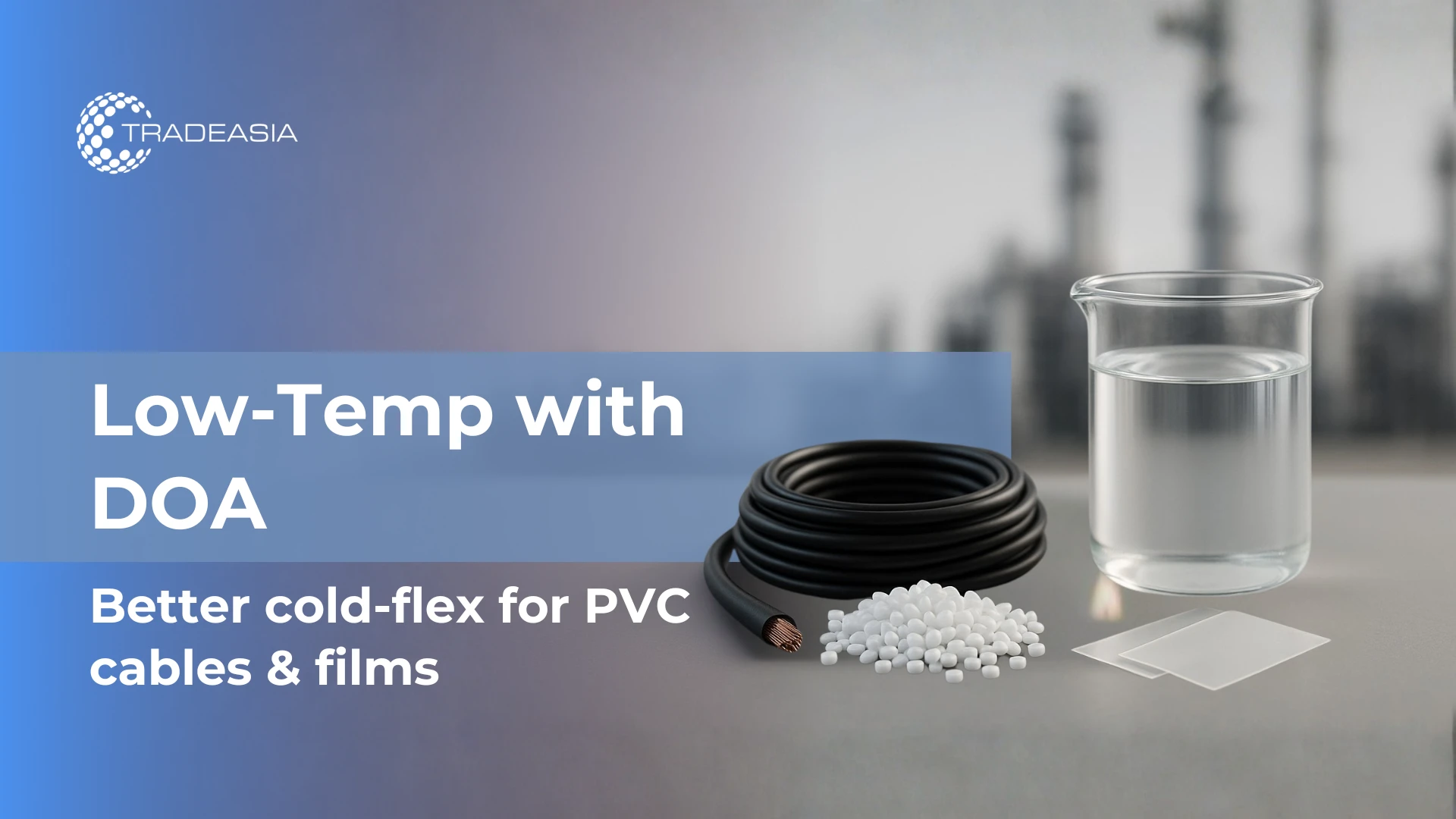
Dioctyl Adipate (DOA) is a benchmark plasticizer for cold flexibility. Its adipate backbone and C8 side chains increase polymer chain mobility, pushing the glass-transition behavior downward so PVC compounds remain flexible as ambient temperatures drop. In practice, DOA often delivers a lower brittleness temperature (BT) than general-purpose plasticizers at similar phr, making it ideal for outdoor cables, freezer films, and cold-climate seals.
Another reason DOA stands out is its balanced volatility and extraction resistance. While highly mobile inside the matrix to deliver cold-flex, DOA’s volatility is sufficiently controlled to limit mass loss during processing and service life. That balance preserves softness, reduces micro-cracking in cyclic freeze–thaw, and stabilizes dimensions under sub-zero stress.
Compatibility is a third pillar. DOA blends well with PVC and can be co-plasticized with DOTP, DINP, or ESBO to fine-tune migration resistance, tensile strength, and aging stability. The result is a multi-objective formulation lever: DOA lowers BT, while companion plasticizers refine mechanicals and long-term durability.
Explore DOA on Our product list.
Treat phr and blend ratio as primary factors in a compact Design of Experiments (DoE). For films, start with DOA 25–40 phr; for flexible cable jackets/insulation, 35–55 phr is common. Cross this with blend levels such as DOA:DOTP = 70:30, 50:50, 30:70 to map trade-offs between BT, tensile/elongation, hardness, and migration.
Capture the essentials per run: BT (ASTM D746/ISO 974), Shore A, tensile and elongation, and loss on heating/extraction. Use response plots to spot the sweet spot where BT improves steeply up to a threshold, after which gains diminish while mechanical penalties appear. For thin-wall cables that demand extreme cold-bend, many labs find ~40–50 phr DOA with 20–40% DOTP in the plasticizer package gives a robust balance.
Add a third factor if needed: stabilizer and lubricant system. Typical starting points: ESBO 3–8 phr (heat stability/compatibility), stearic acid 0.2–0.5 phr (internal lube), PE wax 0.1–0.2 phr (external lube). Record resin K-value, filler grade, and thermal profile to ensure the DoE is reproducible at scale.
Explore our DOTP product page.
Cold environments amplify fogging (condensation + volatile condensates) and blooming (plasticizer migration to the surface). The first line of defense is compatibility balance: DOA is generally compatible, but very high phr or certain polar fillers can shift equilibrium. Co-plasticize (e.g., DOA+DOTP or DOA+DINP) to reduce total volatility and strengthen interaction with the PVC matrix.
For films, incorporate food-contact-compliant anti-fog additives so condensation spreads as a uniform sheet rather than droplets, maintaining clarity in freezers. For cables and seals, avoid over-lubrication; excessive external lube encourages plate-out and surface enrichment. Control resin moisture and die temperature—too cold a die fosters surface gradient of plasticizer; too hot elevates volatility.
Build a real-world conditioning step into QC: stabilize samples at the intended use temperature (e.g., −20 °C for 24–48 h) before testing for fogging/blooming. If symptoms persist, reduce DOA by 5–10%, raise DOTP share by 10–20% in the blend, or consider anti-fog surface coatings for films that face severe condensation cycles.
Flexible PVC Cable — Outdoor/Arctic Rated)
Goal: BT ≤ −30 °C and reliable cold bend. A strong starting point is DOA 45–50 phr, DOTP 15–20 phr, ESBO 5 phr, Ca/Zn stabilizer per supplier, and CaCO₃ ≤10 phr. Results typically show excellent cold-flex without dielectric penalties. If long-term creep is high, shift a few phr from DOA to DOTP to stiffen slightly while holding BT.
Freezer Film — Food Contact)
Needs clarity, toughness, and anti-fog. Try DOA 30–35 phr + DOTP 10–15 phr, a mid K-value resin, and an approved anti-fog package. Die and quench settings affect haze; DOA lowers apparent Tg so films remain flexible at −18 °C. If fogging appears, optimize anti-fog and reduce total volatile ester content.
Automotive Seal — Cold Climate)
Demands low compression set at cold temperatures and limited migration to painted substrates. A PVC alloy with DOA 35–45 phr plus a migration-resistant co-plasticizer and tight internal lubes works well. Aging shows compression set remains low; blooming is contained by improving compatibility (more DOTP) and fine-tuning post-extrusion cooling.
Brittleness Temperature — ASTM D746 / ISO 974
Primary indicator for low-temp performance. Lower is better. Test fresh and after 7–14 days of conditioning to capture equilibration effects.
TR-10 / Low-Temperature Retraction — ISO 2921 (for PVC-rubber blends)
Valuable for seals and PVC-NBR alloys. A lower TR-10 points to preserved elasticity in cold service.
Fogging (e.g., DIN 75201/B for automotive interiors)
Measures deposition on glass plates. DOA blends usually fare well, but additives and process conditions matter; benchmark new blends early.
DSC (Tg), Hardness, Tensile/Elongation
Track Tg shift as a proxy for plastization efficiency. Correlate Shore A and elongation at break with BT trends to detect over-softening.
Migration/Extraction & Volatility
Use standard extraction media (e.g., n-heptane, water) and loss-on-heating. Targets depend on application (food contact, automotive), but trends should align with blend adjustments.
For sub-zero performance, DOA is a high-leverage plasticizer that reliably lowers brittleness temperature while preserving durability. By combining a data-driven DoE, sensible co-plasticization, and targeted anti-fog/anti-blooming controls, formulators can achieve extremely low BT without sacrificing mechanical strength or long-term stability. The winning formula blends chemistry, process discipline, and fit-for-purpose testing. We provide reliable sourcing and versatile plasticizer solutions for Dioctyl Adipate (DOA). Contact us to discuss your specific requirements.
Explore our other plastic product on Technical Product Page.
We're committed to your privacy. Tradeasia uses the information you provide to us to contact you about our relevant content, products, and services. For more information, check out our privacy policy.


 English
 Indonesian
 简体字
简体字
 العربية
 Español
 Français
 Português
 日本語
日本語
 한국어
한국어
 Tiếng Việt