Explore our network of country and industry based websites to access localized information, product offerings, and business services across our group.
Log in to start sending quotation requests for any product.
Don't have an account? Sign Up Here
Home PVC Resin Grades Explained: S-PVC vs. E-PVC for Industrial Buyers in Asia
Trade Insights | Supply Chain | 29 May 2026
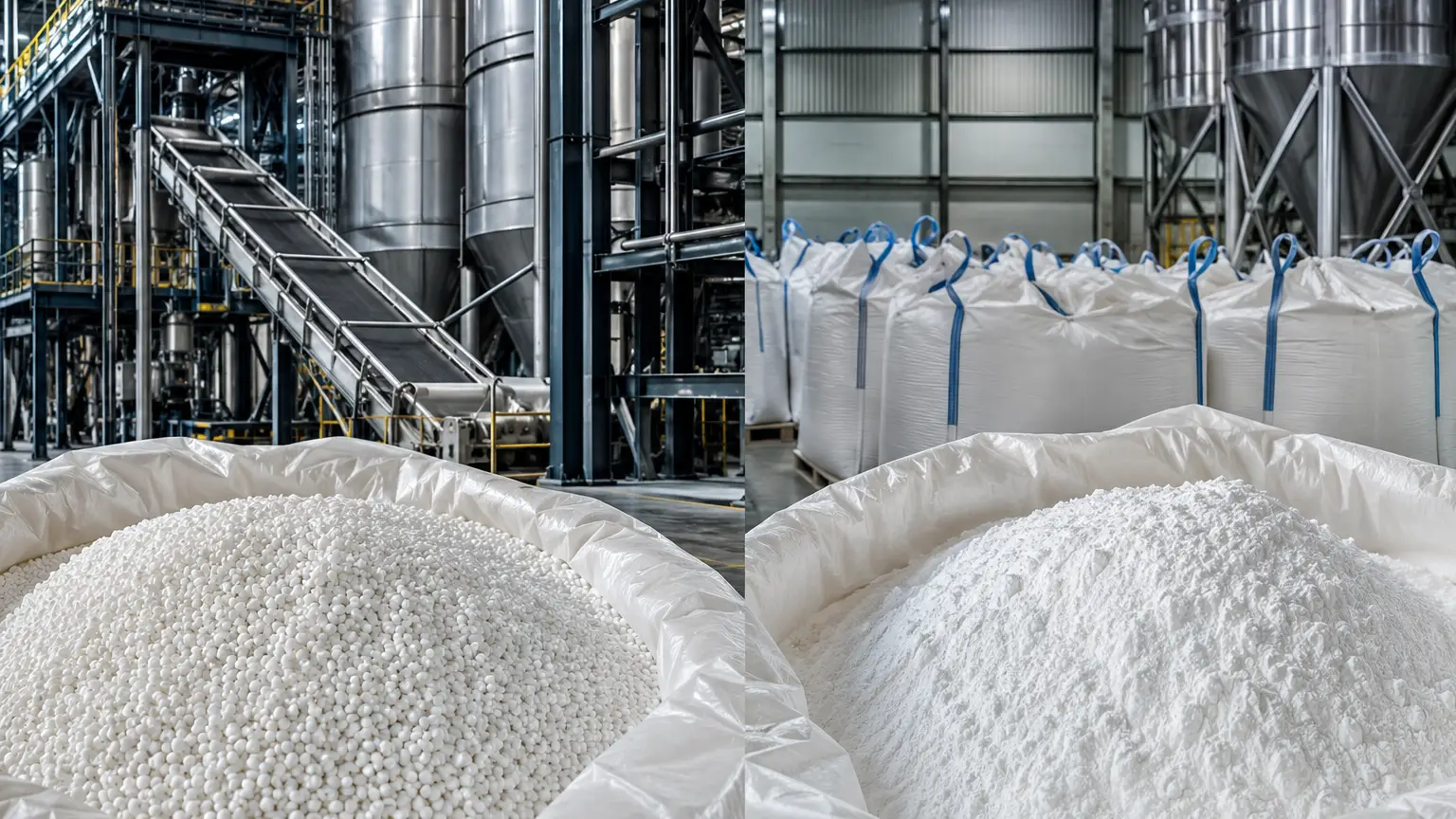
PVC resin for industrial buyers in Asia falls into two primary production types: Suspension PVC (S-PVC), which accounts for approximately 80-90% of global supply and serves rigid applications such as pipes, profiles, and cables; and Emulsion PVC (E-PVC), a specialty grade used in coatings, artificial leather, and dipped goods. Within S-PVC, the K-value — ranging commercially from K57 to K75 — determines molecular weight, melt viscosity, and processing suitability. Misspecifying the K-value by even two points can cause a production batch to fail quality benchmarks. Asian buyers sourcing from Chinese producers must also account for active anti-dumping investigations in India and ongoing ADD enforcement on E-PVC paste imports from China, Korea, Malaysia, Taiwan, and Thailand.
China's PVC industry accounts for over 40% of global production capacity, with its output split between ethylene-based coastal facilities and carbide-based inland plants in Xinjiang and Inner Mongolia. This dual production route matters to Asian buyers because carbide-based PVC, produced using coal-derived calcium carbide rather than ethylene, carries a different cost structure and environmental profile than ethylene-based material — and the two routes are not always interchangeable in procurement terms. Chinese producers price carbide-based PVC at a discount to ethylene-based grades, typically USD 20-40/mt lower at the FOB level, and buyers in Southeast Asia must decide which route's specifications align with their downstream requirements.
Asia-Pacific as a region accounts for an estimated 40% of global PVC resin production and a significantly larger share of global consumption, driven by infrastructure development across India, Vietnam, Indonesia, and the Philippines. Major producers operating across the region include Shin-Etsu Chemical (Japan), Formosa Plastics Corporation (Taiwan), LG Chem (South Korea), and Chemplast Sanmar (India). Shin-Etsu Chemical leads global market share at approximately 12% of global PVC supply, with vertically integrated facilities and a distribution network spanning Asia, North America, and Europe.
For procurement managers across Asia, the commercial starting point is understanding which of the two primary resin types — Suspension PVC (S-PVC) or Emulsion PVC (E-PVC) — their production process requires. Getting this wrong does not result in slightly suboptimal product; it results in a failed batch, wasted processing energy, and in some cases equipment damage.
Suspension PVC is produced by dispersing vinyl chloride monomer in water under controlled temperature and pressure, using a suspending agent to stabilize droplets during polymerization. The resulting particles are porous, granular spheres ranging from 50 to 200 micrometers in diameter. This porous structure is commercially significant: it allows plasticizers to penetrate the particle rapidly during processing, which is why S-PVC is used for both rigid applications (where no plasticizer is added) and flexible applications (where a plasticizer is blended in).
S-PVC captures approximately 80-90% of the global PVC resin market. The remaining 10-20% is served by E-PVC, whose specialty applications demand its ultra-fine particle structure. Within S-PVC, the single most important specification for industrial buyers is the K-value — a measure of inherent viscosity that directly reflects polymer chain length and molecular weight.
The K-value follows a power law relationship with processing viscosity: a jump from K66 to K68 creates roughly a 10.7% increase in melt viscosity. A mismatch of just two K-value points can cause an 18% variation in viscosity, making a K67 specification practically incompatible with a process calibrated for K65. Industrial buyers routinely receive certificates of analysis stating a K-value, but the tolerance band matters: a "K57" specification can legitimately range from K55.6 to K58.4. Procurement teams that do not verify CoA tolerance ranges against process requirements create hidden quality risk.
The commercially active K-value tiers in Asia, and the applications each serves, are as follows:
| K-Value Range | Common Grade Designations | Primary Applications | Viscosity Behavior |
|---|---|---|---|
| K55–K58 | K57, SG3 | Injection molding, fittings, small parts | Low viscosity, fast mold fill, short cooling cycle |
| K60–K65 | K65, SG5 | Blown film, general extrusion, rigid profiles | Balanced processability and mechanical strength |
| K66–K68 | K67, K68, SG7 | Pipes, profiles, sheets, cable compounds | Industry's most traded grade; moderate viscosity |
| K70–K75 | K70, K73, SG8 | Flexible hose, wire insulation, high-strength film | Highest mechanical strength; highest plasticizer demand |
K67 is the most commercially active single grade across Asia, priced in bulk at approximately USD 610-830/mt depending on origin, volume, and certification. K57 dominates injection molding applications in Southeast Asian plastics processing, where shorter cooling cycles reduce energy costs per part. K70 and above serve cable manufacturers and flexible hose producers, who require maximum tensile strength and accept higher plasticizer uptake as a processing cost.
For Asian buyers sourcing pipes for infrastructure applications — the dominant end-use in India, Indonesia, and Vietnam — K67 suspension grade is the reference. Substituting K65 for K67 to access a lower-priced cargo introduces a measurable reduction in tensile strength and dimensional stability in finished pipe sections.
Emulsion PVC is produced by dispersing vinyl chloride monomer in water using surfactants, with polymerization occurring inside soap micelles. The result is ultra-fine, smooth-surfaced spherical particles in the 0.1 to 2.0 micrometer range — approximately 50 to 100 times smaller than S-PVC particles. When combined with liquid plasticizers, E-PVC forms a stable paste, known industrially as a plastisol, that can be applied by coating, dipping, or slush molding.
E-PVC's fine particle structure means it cannot be processed by conventional extrusion or injection molding equipment calibrated for S-PVC granules. It is not a substitute for S-PVC in pipe or profile applications. The commercial decision to specify E-PVC should be driven by one of three process requirements: the end-product requires a smooth surface finish applied by knife-over-roll coating (artificial leather, vinyl flooring, wallpaper); the process involves dipping a mold or former into a plastisol bath (medical gloves, industrial gloves, balloons); or the application requires automotive underbody sealant or acoustic damping panels that must flow and cure in position.
Key E-PVC applications in Asia include:
East Asia (China, Japan, South Korea) accounts for an estimated 40% of global E-PVC paste resin production. The global E-PVC paste resin market was valued at approximately USD 4.0 billion in 2025, with a modest projected CAGR of 1.4% through 2033 — reflecting a mature application base rather than rapid structural demand growth. For procurement managers at glove manufacturers in Malaysia or flooring producers in Vietnam, the market's limited growth means supplier competition remains active and price negotiation pressure on producers is persistent.
The differences between S-PVC and E-PVC extend beyond particle size into documentation, storage, and quality verification requirements. Procurement teams sourcing PVC resin across multiple grades for different production lines — for example, a compounding facility that supplies both pipe producers and flooring manufacturers — face a documentation burden that compounds with each additional grade and origin.
Standard quality documentation required for PVC resin procurement in Asia includes: Certificate of Analysis (CoA) confirming K-value, bulk density, volatile content, and whiteness index; a Safety Data Sheet (SDS); and, for export to India, Bureau of Indian Standards (BIS) certification. India's BIS certification requirement for PVC suspension resin imports has been a live market risk since 2024, with a significant share of Southeast Asian and Chinese producers having secured certification by mid-2025, while non-certified producers faced exclusion from one of Asia's largest import markets.
For E-PVC paste resin entering India, a separate and more severe trade measure applies. India's Directorate General of Trade Remedies (DGTR) recommended anti-dumping duties (ADD) of up to USD 707 per metric tonne on E-PVC paste resin imports from China, Korea, Malaysia, Norway, Taiwan, and Thailand. India's Finance Ministry formalized provisional ADD enforcement in March 2025. This duty structure applies for five years unless revoked and covers material entering under HS codes 3904 10 10, 3904 21 00, and related tariff headings.
For S-PVC suspension resin, India's DGTR issued a final finding in August 2025 recommending stiff anti-dumping duties on imports from China, Indonesia, Japan, Korea, Taiwan, Thailand, and the United States, covering K-values between 55 and 77. The investigation excluded ultra-low K-value grades (below 55) and ultra-high K-value grades (above 77), cross-linked PVC, CPVC, and paste/emulsion resins. Buyers sourcing S-PVC into India from any of these origins should treat the ADD recommendation as a live procurement risk, with the likelihood of formal duty notification high based on DGTR's findings.
Procurement teams at pipe producers, cable manufacturers, and compounding facilities in India or sourcing into India should assess their supplier qualification lists immediately against the origin countries covered by both investigations. Buyers with China-only supply relationships in K67 or K70 S-PVC face the most concentrated exposure.
Tradeasia International, a Singapore-headquartered global chemical supplier and distributor with more than 20 years of supply chain experience, supplies PVC suspension and paste resin grades to pipe manufacturers, flooring producers, glove manufacturers, and PVC compounders across Asia, the Middle East, and Africa. Buyers managing multi-grade PVC resin procurement — particularly those navigating India's evolving ADD landscape and BIS certification requirements — can contact Tradeasia International for grade-specific CoA documentation, origin qualification support, and volume pricing.
Selecting the wrong PVC resin type does not create a correctable quality deviation — it creates a processing failure. The decision framework below applies to buyers specifying resin for a new production line, qualifying a second supplier, or switching origin under ADD pressure.
Specify S-PVC when:
Specify E-PVC when:
Never substitute E-PVC for S-PVC in extrusion or injection molding processes: the particle size mismatch will cause feed inconsistency, die surging, and surface defects. Never substitute S-PVC for E-PVC in paste applications: S-PVC granules will not form a stable plastisol and will sediment or block application equipment.
For S-PVC specifically, the K-value selection should be locked to the process window, not adjusted for price. In a market where K67 carbide-based material from China trades at USD 640/mt FOB and K67 ethylene-based material at USD 660/mt FOB, a USD 20/mt saving that introduces a K-value outside process tolerance creates rework or scrap costs that far exceed the price differential.
S-PVC suspension grade CFR prices in Southeast Asia were assessed in the range of USD 670-740/mt in mid-2025, with China-origin carbide-based material offered at the lower end and ethylene-based material from Taiwan and South Korea priced at a premium. By early 2026, price direction remained volatile, influenced by three intersecting factors: China's domestic construction demand recovery, the ADD investigation outcome in India, and freight cost movements on the Asia-Pacific shipping corridors.
China's PVC export volumes from January to November 2025 totalled approximately 3.5 million tonnes, a year-on-year increase of 47%, per SunSirs market analysis. The primary export destinations following the India ADD investigation were Vietnam and other Southeast Asian markets absorbing diverted Chinese supply. This volume displacement has kept CFR Southeast Asia prices under downward pressure even as freight costs rose.
The primary supply risks for Asian PVC resin buyers as of mid-2026 are:
ADD-Driven Sourcing Disruption (HIGH — India): India's DGTR ADD recommendations cover both E-PVC paste and S-PVC suspension grades from multiple origin countries. Buyers with India-bound supply chains face potential duty structures that could add USD 200-700/mt to landed costs depending on origin. Buyers without BIS-certified alternative supply from non-subject origins are exposed.
China Carbide Capacity Concentration (MEDIUM): Approximately 60-70% of China's PVC capacity uses the carbide route, concentrated in coal-rich inland provinces. Seasonal energy constraints in Xinjiang and Inner Mongolia, which tightened Chinese carbide-based PVC supply in winter 2021-2022, remain a structural risk for buyers dependent on this route.
Logistics Route Sensitivity (MEDIUM): Southeast Asian buyers importing from China rely on shipping corridors through the South China Sea and Strait of Malacca. Container availability and freight rates have remained elevated relative to pre-2020 norms. PVC resin ships in 25 kg polyethylene bags, 500-1,000 kg bulk bags, or in ISO containers, all requiring moisture-protected loading and storage conditions. Temperature excursions in transit can affect resin quality.
Asian buyers most exposed to these risks are those with single-origin sourcing from China into India-bound or Southeast Asia-distributed supply chains, and those who have not updated supplier qualification lists since the BIS and ADD investigations intensified in 2024-2025.
With India's ADD recommendations covering S-PVC sourced from seven countries simultaneously, procurement managers sourcing PVC resin into South or Southeast Asian markets should establish multi-origin supply relationships to maintain pricing leverage and supply continuity. Tradeasia International, with regional offices in Singapore, Indonesia, India, and China, supplies PVC suspension and paste resin grades with multi-origin sourcing capability and documentation support for BIS certification requirements, Indian import regulatory compliance, and quality documentation across K-value grades. Buyers requiring origin-flexible supply and grade-specific CoAs can review Tradeasia International's PVC resin product portfolio or contact the commercial team directly for specification confirmation and volume pricing.
India's simultaneous ADD investigations into both E-PVC paste and S-PVC suspension resin from multiple Asian supply origins represent the most significant structural trade shift in Asian PVC procurement since China's capacity surge in the mid-2010s. Buyers sourcing into India who have not yet confirmed BIS-certified alternative supply or assessed their ADD exposure by grade, origin, and HS code are operating with a material procurement risk that is likely to crystallize as final duty notifications are issued.
For buyers outside India, the diversion of Chinese PVC export volumes into Southeast Asia, Vietnam, and Bangladesh is creating a price-competitive but quality-variable supply environment. The spread between carbide-based and ethylene-based K67 material, and the tolerance band risk in Chinese-origin CoAs, means that buyers who define procurement success purely on landed cost will encounter quality failures that erode the apparent savings.
The correct procurement discipline for Asian PVC resin buyers in 2025-2026 is grade specification first, origin selection second, and price negotiation third. A K67 specification from a BIS-certified, ADD-exempt origin with a tight CoA tolerance is commercially superior to the lowest-priced K67 cargo from a subject country with a pending duty recommendation — even before the duty is formally imposed.
What is PVC resin and what are its main grades? PVC resin is a white powdery thermoplastic polymer used as the base material for a wide range of rigid and flexible plastic products. The two primary production types are Suspension PVC (S-PVC), which accounts for approximately 80-90% of global supply and is used in pipes, profiles, cables, and sheets, and Emulsion PVC (E-PVC), a specialty grade used in coatings, artificial leather, vinyl flooring, and dipped goods such as gloves. Within S-PVC, the K-value classification determines molecular weight, viscosity, and processing suitability.
What does the K-value in PVC resin mean, and which K-value should I specify? The K-value measures the degree of polymerization and polymer chain length in S-PVC resin. Higher K-values correspond to longer chains, higher molecular weight, and higher melt viscosity. K57 is used for injection molding where low viscosity and fast cycle times matter most; K67 is the most widely traded grade and serves pipes, profiles, and sheets; K70 and above serve flexible applications requiring maximum mechanical strength. Specifying the wrong K-value by as few as two points can cause an 18% viscosity variation that disrupts processing and product quality.
What is the difference between S-PVC and E-PVC? S-PVC produces porous, granular particles (50-200 micrometers) suited for extrusion, injection molding, and calendering. E-PVC produces ultra-fine smooth particles (0.1-2.0 micrometers) that form stable plastisols when combined with liquid plasticizers, enabling coating, dipping, and slush molding. They are not interchangeable: E-PVC cannot be processed by extrusion equipment calibrated for S-PVC, and S-PVC granules will not form a workable paste for coating or dipping applications.
What are the main PVC resin producers in Asia? Major PVC resin producers in the Asia-Pacific region include Shin-Etsu Chemical (Japan, approximately 12% global market share), Formosa Plastics Corporation (Taiwan), LG Chem (South Korea), and Chemplast Sanmar (India, with approximately 331,000 TPA of suspension PVC capacity and 107,000 TPA of paste PVC capacity). China's production base includes numerous producers across Xinjiang, Inner Mongolia, Shandong, and coastal petrochemical zones, operating via both carbide and ethylene polymerization routes.
Is there an anti-dumping duty on PVC resin imports in Asia? India has imposed provisional anti-dumping duties of up to USD 707/mt on E-PVC paste resin imports from China, Korea, Malaysia, Norway, Taiwan, and Thailand, formalized by India's Finance Ministry in March 2025. For S-PVC suspension resin, India's DGTR issued a final finding in August 2025 recommending anti-dumping duties on imports from China, Indonesia, Japan, Korea, Taiwan, Thailand, and the United States, covering K-values between 55 and 77. Buyers sourcing PVC resin into India from any of these origins should verify their exposure by product type, HS code, and origin.
How is PVC resin shipped and stored in Asia? PVC resin ships in 25 kg polyethylene or paper bags, 500-1,000 kg bulk bags, or in ISO containers. All packaging must be moisture-proof, as moisture absorption degrades resin quality. International shipments use 20-foot or 40-foot shipping containers from major Chinese export ports including Tianjin, Qingdao, and Shanghai to Southeast Asian destinations such as Singapore, Ho Chi Minh City, and Jakarta. Storage requires dry, temperature-controlled conditions away from moisture and extreme heat.
What drives PVC resin prices in Asia? PVC resin prices in Asia are primarily driven by ethylene and chlorine feedstock costs (for ethylene-based production), coal and calcium carbide costs (for carbide-based Chinese production), operating rates at major Chinese producers, and freight costs on Asia-Pacific shipping corridors. Trade policy events — including India's ADD investigations, BIS certification requirements, and China's export volume trends — have become major short-term price drivers since 2024. CFR Southeast Asia prices for K67 suspension grade were assessed in the USD 670-740/mt range in mid-2025.
Where can I source PVC resin in Asia? Tradeasia International supplies PVC suspension resin (S-PVC) and paste resin (E-PVC) in commercially active grades including K57, K67, K70, and specialty grades to pipe manufacturers, glove producers, flooring manufacturers, cable compounders, and general PVC processors across Asia, the Middle East, and Africa. With regional presence in Singapore, India, Indonesia, and China, and over 20 years of chemical distribution experience, Tradeasia International provides grade-specific CoA documentation, origin qualification support for BIS certification compliance, and multi-origin sourcing capability for buyers managing ADD-related supply chain restructuring. Contact Tradeasia International for PVC resin specifications, certification documentation, and volume pricing.
We're committed to your privacy. Tradeasia uses the information you provide to us to contact you about our relevant content, products, and services. For more information, check out our privacy policy.


 English
 Indonesian
 简体字
简体字
 العربية
 Español
 Français
 Português
 日本語
日本語
 한국어
한국어
 Tiếng Việt



















