1. Introduction: Why 2026 Downgauging Is Now a Procurement KPI
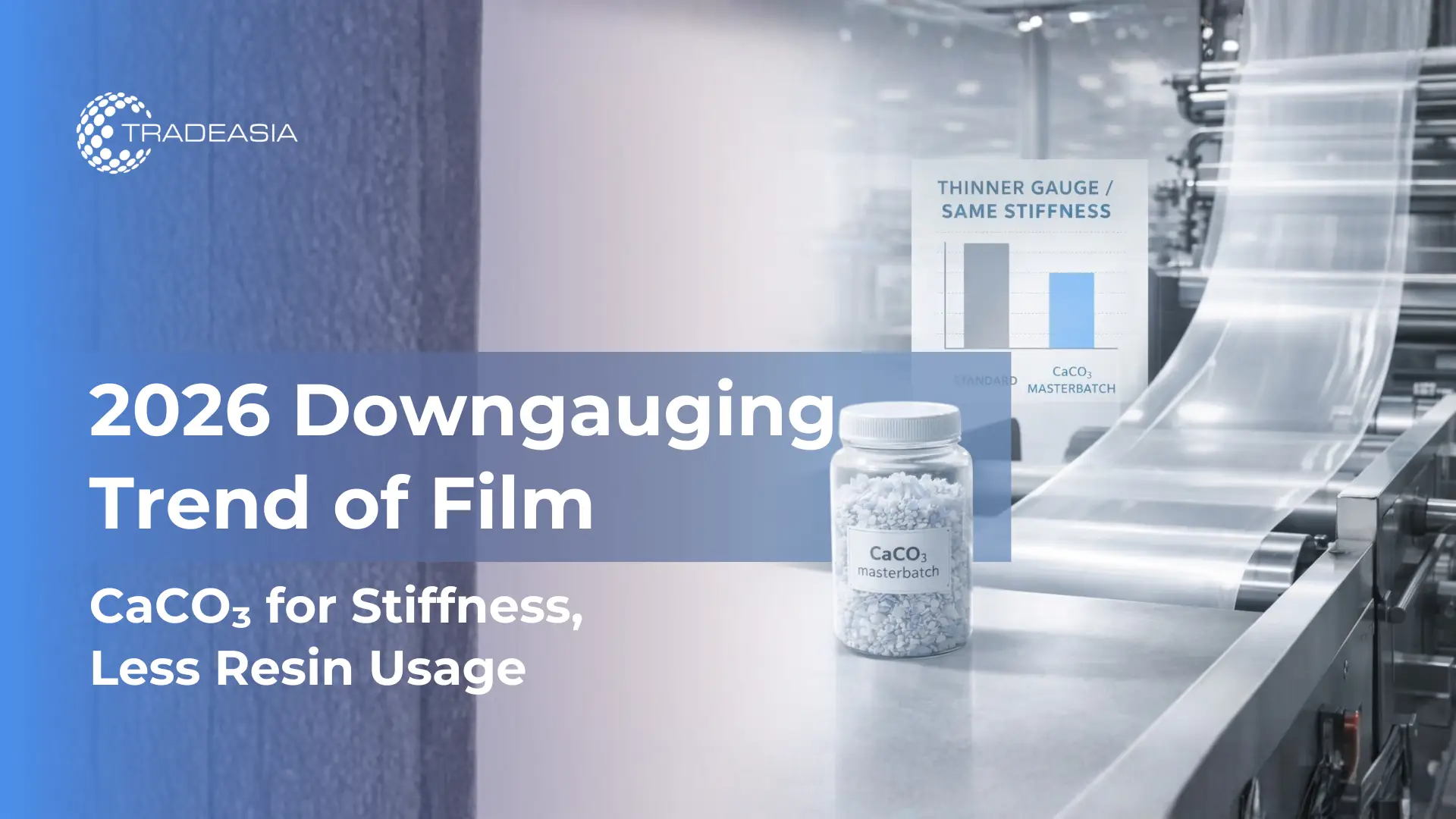
Downgauging in 2026 is no longer “engineering optional”—it’s a procurement KPI tied to cost-down targets, carbon reporting, and packaging performance commitments. Buyers want thinner films that still feel stiff, run fast, and resist failures in distribution, especially for high-volume formats where even small thickness reductions translate into significant resin savings.
CaCO₃ is central to that conversation because it can increase stiffness while reducing polymer consumption per functional unit—but only when film structure, dispersion, and QC controls are engineered properly. Without that discipline, you can trade resin savings for claims, downtime, and customer complaints.
Operationally, the most successful downgauging programs treat CaCO₃ as a design variable: filler loading ranges per layer, dispersion standards, and acceptance testing (modulus/tear/seal/haze) are defined up front. That’s how you convert the “2026 trend” into an auditable manufacturing standard.
For a practical properties reference that connects CaCO₃ loading and processing/stretching effects on PE film performance, this study is a useful internal benchmark: PE Film Properties Study: CaCO₃ Content & Stretching Ratio.
2. LLDPE as the Downgauging Backbone: Why It’s the Default Choice
For downgauging, linear low-density polyethylene is typically the backbone resin because it balances toughness, processability, and practical performance in blown/cast films. When buyers specify thinner gauges, LLDPE is often the safest starting point before introducing filler strategies—especially for packaging, stretch films, and industrial liners.
What many teams miss is that downgauging success depends not only on resin choice but on the interaction between resin grade, process conditions, and the final orientation/crystallinity profile. A 2025 AIP Conference Proceedings study shows how blown film processing parameters (like blow-up ratio) influence LLDPE film mechanical properties—critical when you’re pushing thinner gauges.
This is why procurement language matters: a linear low density polyethylene supplier must provide consistent film-grade behavior and stable processing windows, not just a datasheet. Variation that is “fine” at higher gauges can become a failure mode when your film is thinner.
If your downgauging plan is LLDPE-led, anchor your sourcing and specification baseline here: Linear Low-Density Polyethylene (LLDPE).
3. CaCO₃ in PE Films: What Improves Stiffness—and What Can Break
CaCO₃ increases stiffness primarily by raising composite modulus—rigid mineral particles resist deformation more than the polymer matrix. In commercial reality, the improvement you get depends on dispersion quality, particle size distribution, and surface compatibility; that’s why “same loading” can produce different outcomes across plants and batches.
The trade-offs are equally real: excessive or poorly dispersed CaCO₃ can create weak points, reduce elongation, and increase brittleness—especially when downgauging reduces the “forgiveness margin.” Research literature on CaCO₃-filled polyethylene routinely highlights the importance of matrix–filler interaction and dispersion to avoid defect-driven failure behavior.
For buyers, the correct framing is: you are not merely selecting a powder; you are selecting a controlled specification package (moisture, PSD, coating, and QC discipline). That is why vendor qualification for calcium carbonate suppliers should include evidence of consistency, not only price.
To standardize internal discussions around CaCO₃ identification and documentation workflows (SDS/TDS-style data), use this reference as your shared baseline: Calcium Carbonate Listing.
4. LDPE Layers in Thin Films: Sealability and Line Stability Under Filler Load
In many downgauged structures, LDPE remains important for sealability and forgiving processing—especially in multilayer films where sealing behavior is non-negotiable. When CaCO₃ is introduced to hit stiffness and cost targets, LDPE layers often become the “risk zone” because seal failure is one of the fastest ways to trigger claims.
Filled-polyethylene research shows that rigid fillers can behave like defects if dispersion and interface adhesion are not controlled—this matters at the seal interface where micro-defects can initiate leakage or inconsistent seal strength.
A defensible 2026 approach is layer discipline: place CaCO₃ where stiffness is needed (often core layers) and protect seal layers with tighter filler limits unless trials prove seal strength distribution remains stable. This is how you keep downgauging commercial, not experimental.
For your LDPE sourcing anchor (and to align “LDPE film-grade expectations” across procurement and QA), use: Low-Density Polyethylene (LDPE).
5. HDPE Film Structures: Hitting Stiffness Targets Without Brittleness
HDPE is often selected when stiffness targets are strict—bags, certain industrial films, and structures where higher crystallinity supports rigidity. In downgauging, HDPE can deliver stiffness leverage, but it also increases sensitivity to brittleness and processing windows when thickness drops.
Composite studies show that mineral fillers (including CaCO₃) can improve stiffness, but performance depends on dispersion and interfacial bonding; hybrid filler work in HDPE highlights how formulation choices strongly influence mechanical outcomes.
That’s why a high density polyethylene supplier must be evaluated for film-grade stability, not only for nominal properties. Thin-gauge films amplify small shifts in melt behavior, gels, or contamination—turning “minor variation” into rejects.
For HDPE film-grade referencing and supply alignment, use: High-Density Polyethylene (HDPE).
6. Cost-Saving Math: Converting Gauge Reduction Into $/Ton Wins
Downgauging becomes a board-level win when you can quantify savings: less polymer per package, improved output per ton, and reduced cost per functional unit. The second lever is substitution—CaCO₃ filler masterbatch can reduce compound cost while supporting stiffness targets, when engineered correctly.
An industry case study explains how CaCO₃ filler masterbatch is applied in PE film to support cost-saving objectives while maintaining performance expectations—useful as a “commercial story” benchmark when building internal buy-in.
But buyers should treat case studies as directional—not universal. Your actual savings must be validated against your film structure, sealing requirements, optical targets, and rejection risk. The best procurement play is to require a trial plan with acceptance limits (modulus/tear/haze/seal/COF) and a rollback rule if drift appears.
For a concrete cost-saving reference that procurement teams can quickly understand, review: CaCO₃ Filler Masterbatch for PE Film (Cost Saving Case Study).
7. Recycling Reality: Why Contamination and Separation Still Decide Yield
In 2026, downgauging is increasingly judged alongside recyclability and downstream yield. Even if CaCO₃ improves stiffness, the overall packaging ecosystem still punishes contamination and poor separation—because yield loss destroys the economics of recycling and undermines sustainability claims.
A classic Polymer Degradation and Stability paper shows why PVC contamination is “extremely dangerous” in PET recycling due to HCl evolution and chain scission—this is a reminder that material integrity and sorting control remain decisive in real recycling systems.
The takeaway for film downgauging programs is broader than PET: your material design must anticipate the realities of sorting, wash systems, and contamination thresholds. “Better film” is not only stiffness; it is also compatibility with recycling streams and predictable quality outcomes.
For an operational explanation of how PVC contamination disrupts PET recycling (useful as a recycling-risk analogy in internal training), see: PVC Contamination in PET Recycling.
8. Qualification & Documentation: What Buyers Must Collect Before Trials
The fastest downgauging failures come from documentation gaps: missing TDS/SDS, unclear filler specification windows, or incomplete QC evidence. In 2026, buyers should request a minimum “qualification pack” before trials: resin datasheets, additive/filler specs (including moisture/PSD/coating where applicable), COA practices, and test method references.
Regulatory/industry frameworks increasingly emphasize systematic recyclability and technical assessment approaches—meaning packaging material decisions are becoming more evidence-driven, not less. This makes documentation discipline a competitive advantage.
Internally, treat documentation as risk control: if haze spikes, seal fails, or recycling questions appear later, your baseline spec package becomes the first line of troubleshooting. This reduces debate and accelerates corrective action.
To streamline trial qualification and give QA/procurement a single place to pull documents, use: Plastradeasia Download Center.
9. Procurement & CTA: Lock Specs, Secure Supply, Reduce Risk
A 2026 downgauging procurement strategy must prioritize repeatability: stable resin behavior, stable filler/masterbatch performance, and fast technical response when drift appears. This is where buyer maturity shows—spec-first contracting beats price-first buying because off-spec events erase negotiated savings.
Processing research on blown film shows that film properties are strongly influenced by process parameters; when you downgauge, your tolerance window shrinks, so supplier consistency and technical alignment matter even more.
Commercially, the right move is a two-stage sourcing process: (1) lock a spec and trial protocol, then (2) negotiate volume and pricing based on validated performance and QC capability. That is how you de-risk “calcium carbonate suppliers” selection and protect output stability.
For bulk orders, cross-grade sourcing (LLDPE/LDPE/HDPE + CaCO₃ strategy), and technical alignment before trials, contact the team here: Contact Plastradeasia.
10. Conclusion: 2026 Downgauging Checklist + All Key Links
In 2026, film downgauging succeeds when it is engineered as a controlled system: resin platform first, CaCO₃ strategy second, layer discipline always, and documentation before scale-up. The market direction is clear—less material, same functionality—but buyers will only capture value if their specs and trials are defensible.
Use this practical checklist: (1) select a stable linear low-density polyethylene backbone, (2) define CaCO₃ loading windows by layer, (3) protect LDPE seal layers unless proven, (4) validate HDPE stiffness structures against brittleness risk, (5) quantify savings with an acceptance-based trial plan, and (6) package everything into an audit-ready documentation pack.
Start by aligning your film resin options with LLDPE, LDPE, and HDPE, then standardize CaCO₃ documentation and supplier discussions via Calcium Carbonate Listing. Use the operational benchmark CaCO₃ PE Film Cost-Saving Case Study to justify the economics, and keep the technical benchmark PE Film Properties Study: CaCO₃ Content & Stretching Ratio available for internal QA discussions. For recycling-risk awareness and contamination learning, reference PVC Contamination in PET Recycling. Finally, accelerate qualification via Plastradeasia Download Center and convert your validated spec into a supply contract through Contact Plastradeasia.
Leave a Comment