1. Introduction
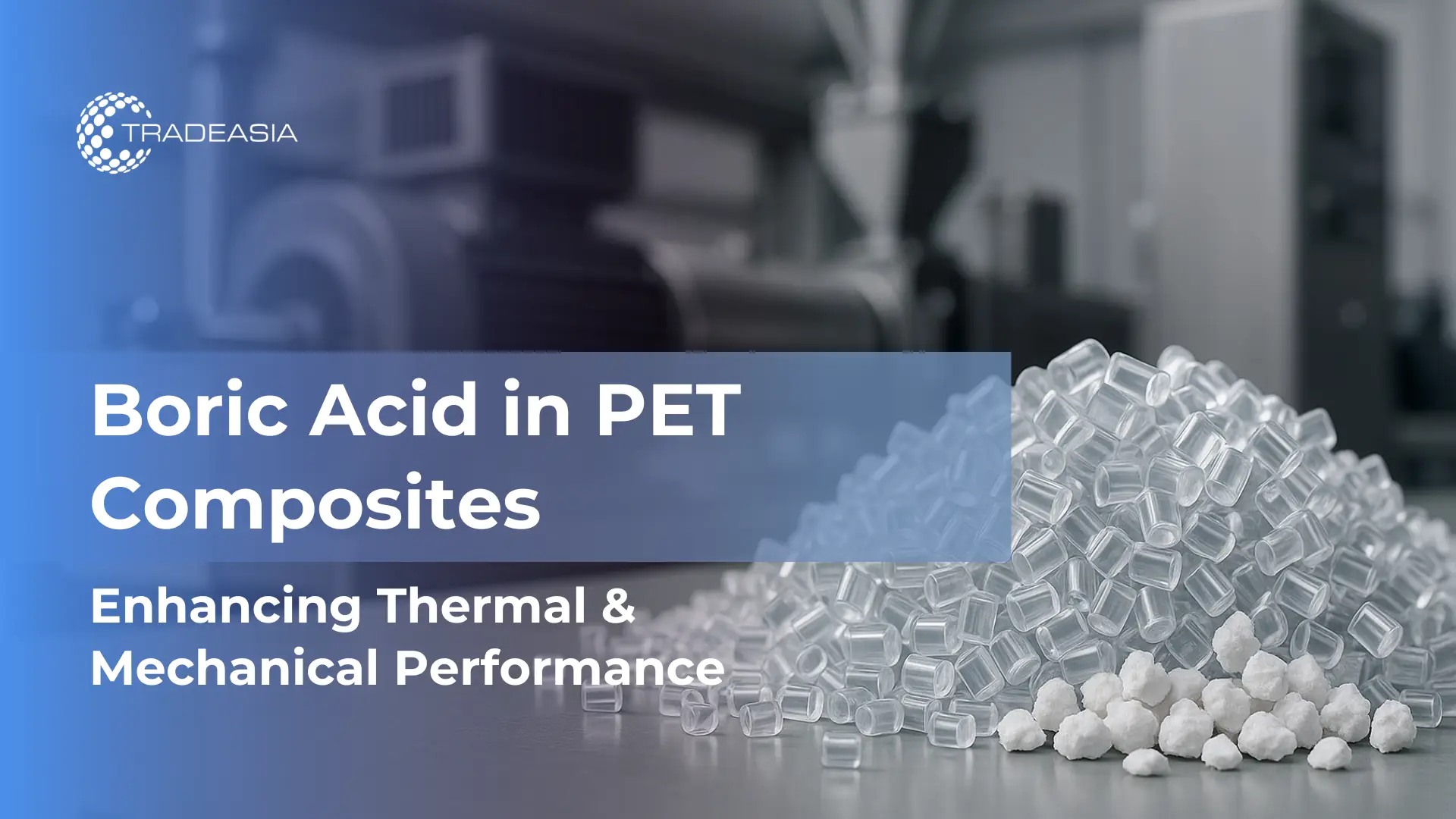
Polyethylene Terephthalate (PET) has long been recognized as one of the most versatile polymers in the plastics industry, used extensively in packaging, fibers, engineering parts, and composite materials. As industries push for higher-performance materials, PET is increasingly reinforced, blended, or modified to improve heat resistance, stiffness, and long-term durability. One of the most effective specialty additives used in this enhancement process is boric acid, a compound known for its unique thermal and structural benefits in polymer systems.
Boric acid offers multiple functional advantages, including improved heat stability, flame retardancy, and mechanical reinforcement—making it particularly useful for PET composites used in automotive, electrical, and industrial sectors. Scientific literature from ScienceDirect emphasizes the effectiveness of boron-based additives in enhancing polymer flame resistance and structural stability, validating its role in modern PET engineering.
Another important factor is boric acid’s ability to interact with polymer chain structures, influencing crystallization behavior and mechanical performance. This interaction is valuable not only for PET but also for HDPE, PA, PBT, and other engineering plastics that require dimensional control under heat. Manufacturers seeking high-performance polymer solutions increasingly view boric acid as a strategic additive.
For PET sourcing, Plastradeasia provides high-quality PET materials suitable for extrusion, molding, and composite applications:
2. Why Boric Acid Matters in PET Composite Engineering
The value of boric acid in PET composites begins with its fundamental chemical behavior. Boric acid participates in ester exchange reactions and hydrogen bonding, directly affecting PET’s thermal and mechanical properties. Research published by Springer Materials shows that boron-containing additives contribute to more stable polymer matrices, especially when subjected to repeated thermal cycling. This makes boric acid highly relevant for engineering-grade PET applications.
Additionally, boric acid serves as an effective flame retardant synergist when combined with other fire-resistant additives. PET, while inherently strong, is susceptible to dripping and deformation under fire exposure. Incorporating boric acid helps reduce flame spread and enhances char formation, improving PET’s safety profile for electrical and automotive components.
From a manufacturing perspective, the presence of boric acid can improve PET processing by influencing crystallization kinetics. Faster and more controlled crystallization reduces cycle times in injection molding and thermoforming operations. Industries that rely on fast throughput—such as beverage packaging or electronics casings—benefit significantly from these improvements.
Manufacturers seeking reliable boric acid supply for composite formulations may source from Chemtradeasia’s global network:
3. Improvements in Thermal Stability Using Boric Acid
Thermal stability is a critical requirement for high-performance PET composites, particularly in automotive, aerospace, and electrical components. Boric acid enhances PET’s resistance to thermal degradation by stabilizing polymer chain structures. According to Wiley Online Library, boron-containing additives significantly slow thermal oxidation and improve polymer heat resistance. This makes boric acid an essential additive for applications that demand sustained heat exposure.
Boric acid’s role in modifying the decomposition pathway of PET further supports its suitability for high-temperature environments. By promoting char formation and reducing volatile release, boric acid helps PET maintain structural integrity when exposed to external heat sources. This is particularly important in components like electrical housings or engine-adjacent parts.
In PET foams or reinforced sheets, boric acid improves dimensional stability and prevents warping during thermal cycling. Manufacturers seeking materials capable of maintaining tolerance under fluctuating temperatures find boric acid-enhanced PET particularly advantageous.
For additional supply options, Chemtradeasia offers boric acid produced in Chile for industrial-grade polymer use:
4. Mechanical Performance Enhancements in PET Composites
Beyond thermal benefits, boric acid contributes to improved mechanical performance in PET composites. This improvement is especially pronounced in PET reinforced composites used in automotive panels, appliance housings, or construction materials.
By modifying crystallinity and promoting tighter chain alignment, boric acid helps produce PET materials with greater stiffness and reduced creep. This performance boost is critical for components subjected to constant mechanical loading or long-term stress.
Boric acid also enhances interfacial bonding in fiber-reinforced composites. In PET + fiberglass or PET + mineral-filled systems, boric acid improves adhesion and load transfer between phases. This results in stronger, more durable composite components with improved impact resistance.
For supply reliability, Chemtradeasia provides high-purity boric acid from Peru suitable for reinforcement applications:
5. Applications of PET + Boric Acid Composites in Industry
Industries adopting boric acid-enhanced PET composites span across automotive, engineering, packaging, textile machinery, and consumer electronics. Components such as electrical enclosures, battery holders, automotive trim parts, and heat-resistant casings benefit from improved thermal stability and rigidity. Numerous studies documented on MDPI Polymers Journal confirm the suitability of boron-modified polymers for structural and semi-structural applications.
In PET packaging, boric acid can enhance stability during high-temperature sterilization processes used for food and beverage applications. This modification enables PET to withstand hotter filling temperatures or extended pasteurization cycles. Packaging companies increasingly explore these options as they move toward more durable yet lightweight solutions.
For fiber and textile applications, boric acid-modified PET fibers exhibit better resistance to heat and abrasion, extending service life in industrial fabrics or filters. These enhancements are particularly valuable for high-performance textiles used in filtration systems or geosynthetics.
Manufacturers seeking alternative polymer supply options related to PET, such as HDPE, may explore Plastradeasia’s offerings:
6. Choosing the Right Boric Acid and PET Grades
Selecting the right combination of boric acid grade and PET resin is crucial for maximizing composite performance. Industrial-grade boric acid with consistent particle size distribution and high purity ensures predictable behavior during compounding and molding. Chemtradeasia’s Turkish-origin boric acid is widely chosen for precision polymer applications:
For PET resin selection, factors such as intrinsic viscosity (IV), crystallinity, and melt flow index influence mechanical and thermal outcomes. PET with higher IV is preferred for structural composites, while medium-IV grades suit thermoforming and extrusion applications. Plastradeasia provides PET grades that meet global specifications for engineering plastics.
Additional additives—including alum—may be used alongside boric acid depending on the desired performance profile. Alum can improve stiffness and flame retardancy in plastic applications requiring further reinforcement. For reference, manufacturers may review Chemtradeasia’s alum listing:
Technical documents, formulation support, and polymer specifications can also be downloaded from the Plastradeasia resource center:
7. Conclusion
Boric acid plays a strategic role in enhancing the performance of PET composites, making them more thermally stable, mechanically resilient, and suitable for demanding industrial environments. Its influence on crystallinity, decomposition behavior, and interfacial adhesion enables manufacturers to engineer higher-value PET materials for automotive, electrical, packaging, and reinforcement applications.
Companies seeking boric acid suppliers can explore Chemtradeasia’s global offerings (Bolivia, Chile, Peru, Turkey):
For polymer sourcing—including PET and HDPE—visit Plastradeasia:
Additional materials and additive references such as alum are available at:
Manufacturers requiring technical assistance, supply chain support, or bulk procurement may contact Plastradeasia directly:
Downloadable data sheets can be accessed here:

Leave a Comment