1. Introduction
PET recycling economics are unforgiving: your margin depends on high yield, stable color/IV, and consistent flake/pellet quality. When “foreign polymers” enter the PET stream, the recycler pays twice—first in sorting cost, then again in downgraded output, higher reject rates, and customer claims. Among contaminants, PVC is widely treated as the most damaging because it can compromise PET during melt processing.
For recyclers and packaging stakeholders, this is not just a technical issue—it is a supply-chain issue. A recycler can run excellent washing and still lose value if incoming bales contain PVC labels, sleeves, or look-alike containers. That is why upstream packaging design guidance and downstream process discipline must work together to protect the PET value chain. Packaging Covenant.
From a commercial standpoint, companies investing in pet Polyethylene Terephthalate suppliers and rPET programs want “bankable” quality: stable output that meets converter and brand-owner specifications. The more you reduce PVC risk, the more reliably you can sell into higher-value applications (fiber, sheet, and—where permitted—food-contact pathways).
If your organization is sourcing PET materials (virgin or recycled) and wants product-aligned references, Plastradeasia’s PET page is a useful starting point for specification context:
2. Where PVC Contamination Comes From in PET Streams
PVC contamination typically enters PET recycling through a few repeat offenders: PVC shrink sleeves, PVC labels, PVC bottles/containers that visually resemble PET, and occasional cross-contamination from mixed bale sources. Because PET and PVC can look similar in the field, the contamination risk increases when collection systems are inconsistent or when sorting relies heavily on manual steps.
The commercial impact is disproportionate: recyclers often report that PVC needs to be controlled to very low levels to avoid major quality failures in rPET. Industry-focused explanations commonly highlight “very low ppm” thresholds where PVC becomes a serious threat to PET processing stability and final material appearance. Petbottlewashingline.
Brand-side design choices also matter. Recyclability guidance from organizations like APR emphasizes packaging component design (labels, sleeves, closures) because these components can directly influence contamination rates and sorting success. Plastics Recycling.
From an environmental perspective, PVC creates added complexity in mechanical recycling streams and can increase the burden of managing outputs and residues—one reason many sustainability discussions flag PVC as a challenging material in mixed recycling contexts. Sustainability-directory.
3. Why PVC Resin Presence Is Hard to Eliminate Without Upstream Controls
A common misconception is that “better washing” alone can solve PVC contamination. In reality, washing helps remove adhesives, dirt, and organics—but it cannot reliably remove PVC if PVC enters as polymer-in-polymer contamination (e.g., sleeves, label substrates, or entire PVC items that slip through sorting). That’s why upstream controls—collection rules, packaging design discipline, and strict bale specifications—remain essential.
PVC also exists in many product forms and resin routes, which increases the chance that PVC appears in the same waste ecosystem as PET. When recyclers and converters manage mixed packaging portfolios, preventing PVC migration into PET streams often requires deliberate procurement and material governance: supplier declarations, component restrictions, and component-level audits aligned to recyclability guidelines. RECOUP
For buyers and manufacturers sourcing PVC for unrelated applications (pipes, cable compounds, profiles, films), clarity in sourcing and grade control can indirectly support recycling outcomes by reducing accidental cross-stream mixing. Plastradeasia provides PVC resin references and categories here:
If you need resin-specific procurement references, these product pages can support internal alignment on PVC resin identification and purchasing controls (especially when teams manage both PET and PVC supply chains):
4. The Science: How PVC Degradation Damages PET During Processing
PVC becomes especially dangerous when PET is melted and processed. PET processing temperatures can trigger PVC degradation reactions that release hydrogen chloride (HCl). That HCl can catalyze PET chain scission—lowering molecular weight, hurting mechanical properties, and driving discoloration and brittleness in the final recycled polymer.
A classic peer-reviewed study directly addresses this mechanism and explains why even small amounts of PVC are “very dangerous” in recycled PET due to chain scission caused by HCl evolved during PVC degradation. ScienceDirect.
Practically, this is why PVC contamination is not just a “speck” problem—it is a chemistry problem. Once degradation byproducts form in the melt, the impact can spread beyond a single defect: color shifts, haze, reduced intrinsic viscosity, and inconsistent processing behavior can affect the entire batch.
For procurement teams, this science justifies strict incoming QC and supplier requirements. It also explains why recyclers who want premium rPET often build “zero tolerance” policies around PVC, including strict bale acceptance criteria and targeted sorting technologies.
5. How Salt Brine (NaCl) Separation Reduces PET Recycling Losses
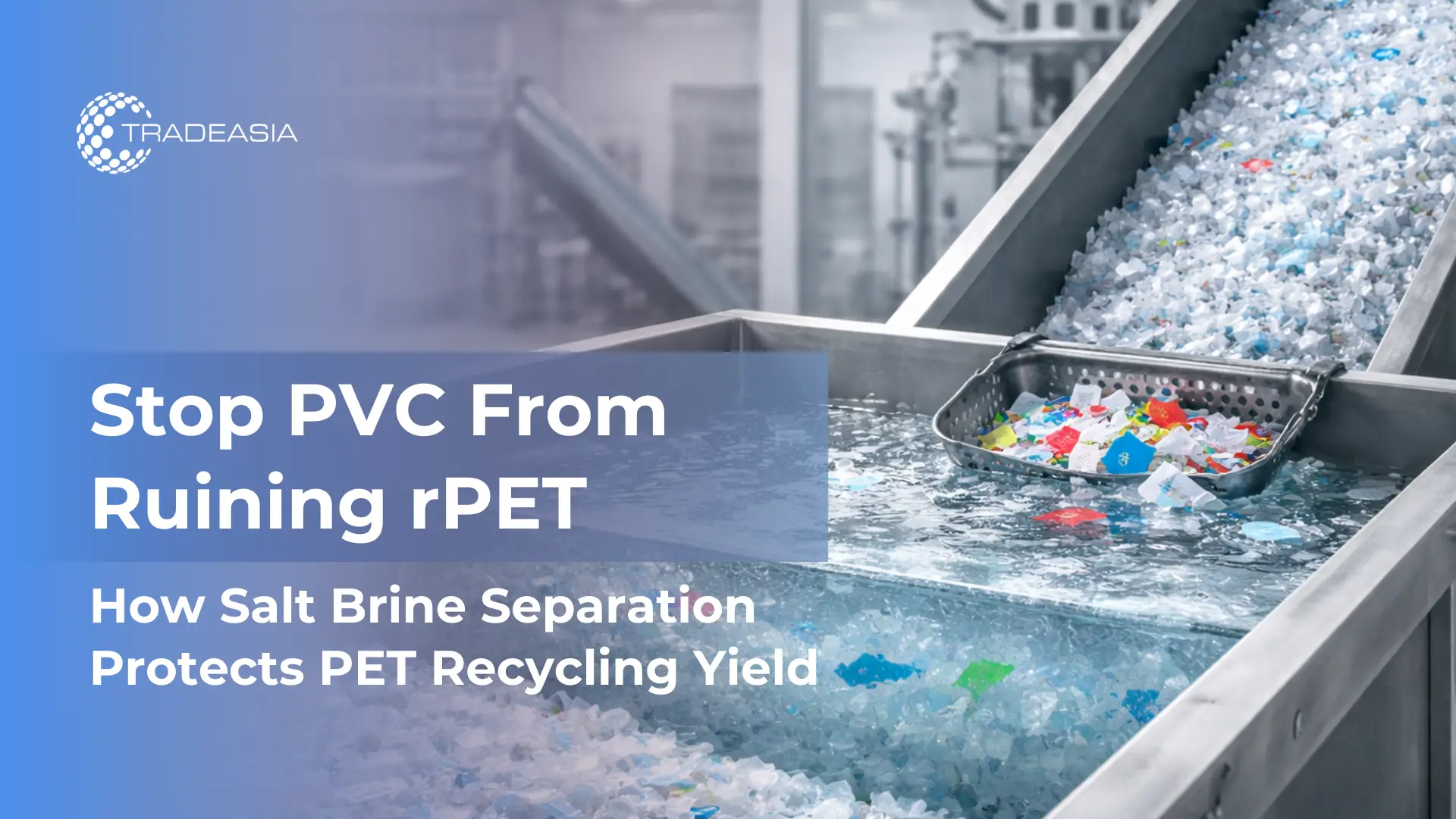
Salt brine separation is a practical tool recyclers use in density-based separation systems. The concept is straightforward: adjust the fluid density to “float” certain plastics while others “sink,” improving removal of contaminants and protecting PET purity. This is one of the most recognizable places where nacl in plastic industry becomes operationally important, not theoretical.
However, recyclers must be realistic: PET and PVC densities overlap significantly, so conventional water-only float/sink separation is not a complete solution for PVC removal. That said, brine systems still add value by improving separation of other contaminants (like PP/PE), stabilizing washing line performance, and reducing non-PET carryover—making downstream PVC detection and ejection more effective. Technical literature discusses why PET–PVC separation is challenging using conventional gravity separation alone due to overlapping specific gravities. P2 InfoHouse
This is where sourcing matters. Brine performance depends on consistent salinity control, filtration, and recirculation discipline. Many operations standardize procurement from industrial salt suppliers to ensure stable quality and predictable brine performance over time.
If your line requires procurement support for salt inputs, Chemtradeasia provides an industrial salt reference page useful for buyers evaluating Sodium Chloride suppliers and nacl suppliers for recycling operations:
6. Operational Playbook: Sorting, QA, and Documentation for High-Purity rPET
To reduce PVC-driven losses, best-performing recyclers treat PVC control as a system: upstream bale specs + front-end sorting + in-line detection + melt-quality monitoring. Common practical steps include NIR sorting tuned for PVC detection, color sorting for look-alike materials, aggressive label/sleeve management, and strict rejection thresholds tied to customer specs.
Equally important is documentation. When recyclers sell into demanding applications, customers expect traceability: COA-style test results, process control logs, and clear acceptance criteria. Industry guidance like APR’s design and recycling testing frameworks exists precisely because packaging components strongly affect recyclability and contamination outcomes. Plastics Recycling
From a commercial procurement standpoint, documenting your contamination controls can unlock better pricing and longer contracts. Buyers of rPET want risk reduction, and “proof” (spec sheets, QC methods, compliance docs) is how you convert operational discipline into commercial advantage.
To support internal qualification, customer onboarding, and technical alignment, Plastradeasia provides centralized technical resources here:
7. Conclusion
PVC contamination threatens PET recycling because the damage is chemical, not cosmetic: when PVC degrades during PET processing, its byproducts can trigger PET chain scission and drive widespread quality failure. That is why high-value PET recycling programs combine upstream design discipline, strict bale acceptance, and targeted separation strategies—including brine-based process control—to reduce losses and protect premium rPET outputs.
If your organization needs PET sourcing context to align resin specs, supplier qualification, or recycling input strategy, Plastradeasia’s PET reference page supports pet Polyethylene Terephthalate suppliers and distributor discussions:
If you are tightening PVC governance to prevent cross-stream contamination—or managing PVC procurement alongside PET programs—these pages help standardize internal naming, resin identification, and purchasing controls for pvc Polyvinyl Chloride suppliers:
Or explore any PVC related products on our Categorized PVC page:
If your recycling line depends on density separation chemistry and stable brine operation, consistent sourcing from industrial salt suppliers matters. This is where nacl suppliers and verified Sodium Chloride suppliers support real yield protection—not just cost control:
To make your PVC-control program auditable and customer-ready, ensure your team can quickly access specs, SDS/TDS, and supporting documentation for qualification and sales conversations:
Finally, if you want to reduce rPET loss, improve bale specs, or secure supply pathways (PET, PVC, and salt inputs) with technical support, Plastradeasia can assist with bulk inquiries and documentation-driven sourcing decisions:



Leave a Comment